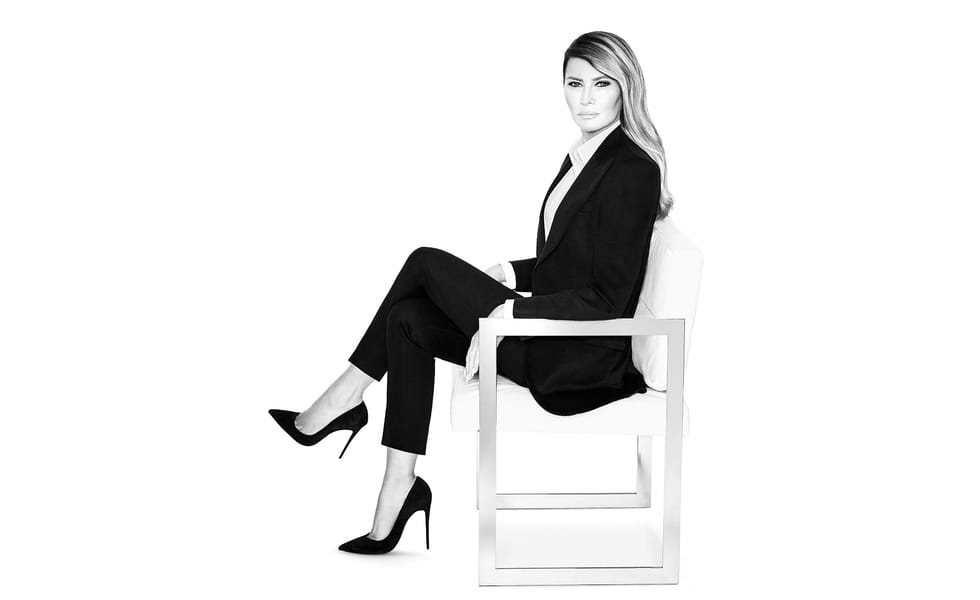
Paper-thin, superficial, and interminably boring, Melania would be an embarrassment if anyone involved was capable of shame.
How much do you know about Melania Trump?
Probably not much.
The Slovenian former model, wife to Donald and mother to Barron, has always been something of a cipher – a razor-cheeked absence of body fat in haute couture, inscrutable behind dark glasses, often seen swanning down red carpets or hovering in the background at press conferences, but rarely heard. Her biggest cultural footprint is a result of her stepping in it when she wore that infamous “I Don’t Really Care, Do U?” coat, an incident that was more of a Rorschach test than a newsworthy event. We saw the flipside when Sussan Ley tried to drum up a scandal over Albo’s Joy Division t-shirt. People will read what they want in the entrails.
How much do you care about Melania Trump?
Probably not much, but it’s a better question. The First Lady is only important because of her proximity to power and influence, but wields little of her own. Still, you might be curious; there’s got to be something in her story, the journey from then-communist (and then-extant) Yugoslavia to the catwalks of Europe, and then onto the White House. You’d have to try pretty hard – or be working under some pretty tight strictures – to make something boring out of that.

Well, Brett Ratner has managed it. It’s arguably not his fault – he’s out of practice, after all. Melania is both his first feature documentary as director and his first feature film since 2014’s Hercules, his career having collapsed into a flaming heap after numerous women accused him of sexual misbehaviour in 2017. Melania marks his return to filmmaking and now a fourth Rush Hour film is being mooted by Paramount Skydance, the studio owned by Trump ally David Ellison, so we can all look forward to Jackie Chan (who can no longer do his own stunts) and Chris Tucker (who can no longer be funny) reuniting under the direction of Brett Ratner (who can no longer pretend to be anything other than scumbag). So it goes.
Paramount Skydance did not, funnily enough, stump up the cash for Melania. Amazon did, spending US$40m for the privilege, plus around 35 mil on promo. The next highest bid reportedly came from Disney, who offered $14m. That is, by any resonable measure, an insane price tag on any documentary, factual films normally having a harder time of it at the box office than fiction. It would have to be not just a masterful work – plenty of extraordinary documentaries have struggled to pay for themselves – but a capital E event: the must see movie of the year.
Well, it’s not, despite massive efforts to the contrary, such as the gala premier at the Kennedy Centre; box office has been torpid, although on my first watch (a technical issue meant I had to sit through the thing twice, no preview screenings being offered to the press) was about two thirds full of the most joyless people alive. I suspect it’ll do better on streaming, for a variety of reasons. But it’s here now, in cinemas, so: how is it?
Dreadful, of course. Morbidly fascinating, mind you, but genuinely terrible. It’s taken me this long to get to actual film, because there’s little to say about it – everything around it is far more interesting.
And yes, I know, I know: I’m an old working class leftie, so my opinions are suspect from the jump. But here’s the thing: I don’t mind a spot of conservative art. Some of my favourite artists over the years have been staunch right-wingers. True, most of them are dead now, and it’s much easier to admire the work of someone who is actively fertilizing the cemetery rather than actively enabling crimes against humanity (or being accused of more mundane crimes and bolting off to Israel to pal around with Netanyahu, as the case may be).
Filmmaker John Milius, who once described himself “…a right-wing extremist so far beyond the Christian Identity people…that they can’t even imagine” is still going, though, and you will have to pry the former NRA board member’s Conan the Barbarian from my cold, dead hands. D.W. Griffith’s 1915 proto-epic The Birth Of A Nation, which climaxes with the Ku Klux Klan heroically riding down hordes of rampaging black men before engaging in a bit of armed voter suppression, is nigh-universally regarded as one of the most important films of all time. Leni Reifensthal, Hitler’s pet shot-caller, made Triumph Of The Will (1935) and Olympia (1938) – both beautiful films, both unapologetic Nazi propaganda. Paulin Kael called them “The two greatest films ever directed by a woman.” How good is Mel Gibson’s Apocalypto?
Very good, as it happens. Melania, however is not. Somehow both polished and ugly, carefully constructed and utterly lackluster, it’s a 104 minute slog. I might disagree with the film’s largely implied politics, but that doesn’t mean I don’t know a dud when I see one. On a craft and narrative level, Melania is a catastrophic failure.
The film follows its eponymous subject over the course of the 20 days leading up to Donald Trump’s second inauguration on January 20, 2025. We open to the strains of The Rolling Stones’ “Gimme Shelter” (they don’t own the rights, gang) as we track over the Atlantic Ocean and up onto the Florida shore abutting – where else? – Mar-A-Lago, then into a motorcade, and onto a private plane. Patchy, stilted voiceover from Melania herself gives us the narrative gist. And the gist, more or less, is party planning. We spend a lot of time with fashion designers, event planners, and various other functionaries as Melania approves menus, frowns at the cut of her inauguration dress, and general gets the big machinery of the inauguration’s social dimension into gear. We spend a lot of time in motorcades or walking through parking garages flanked by security. At times it feels a bit like reality TV – Real Housewives Of The East Wing, perhaps. What it really reminded me of is the self-aggrandising documentary about himself that Marky Mark’s Dirk Diggler makes in Boogie Nights.
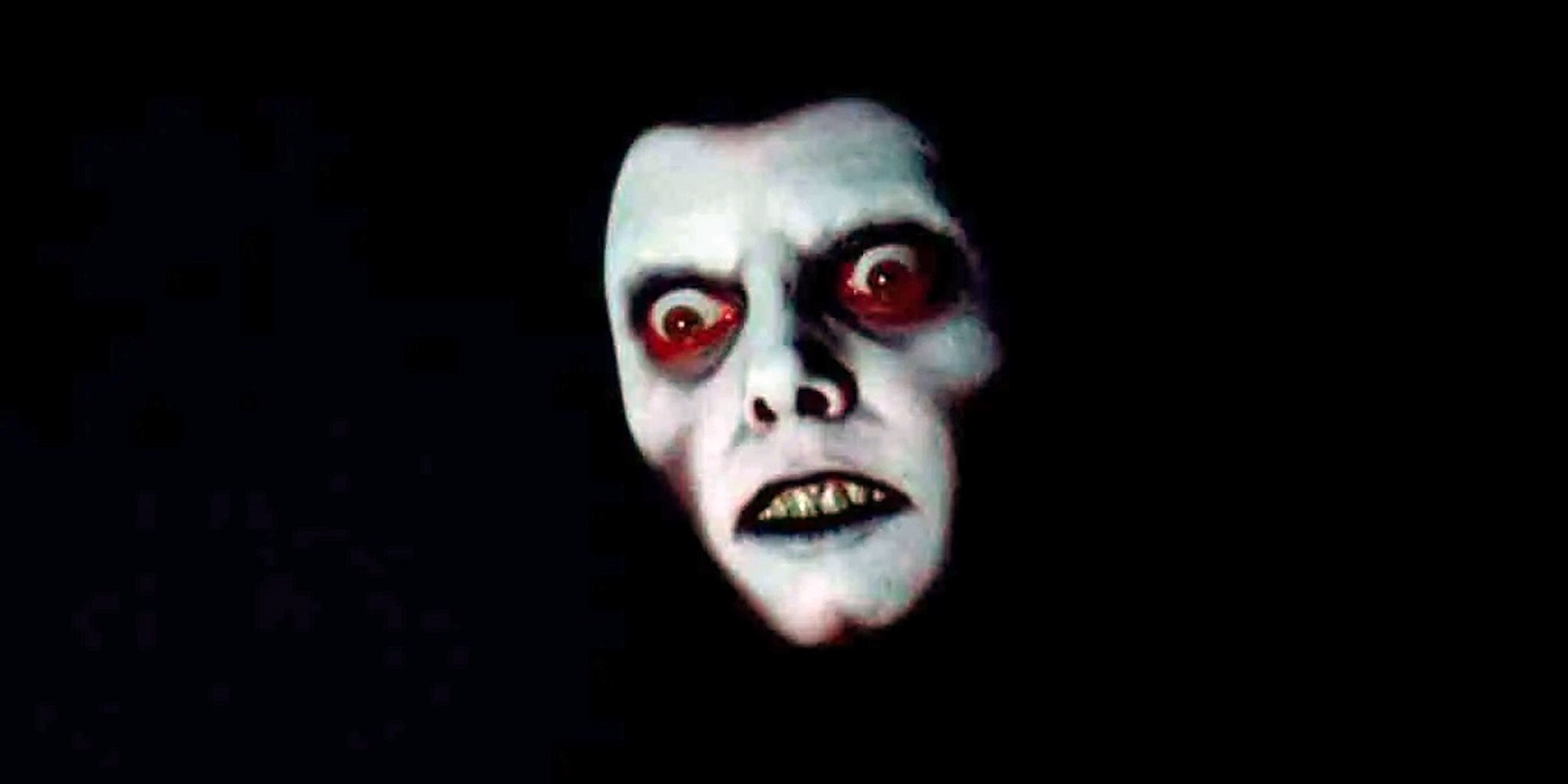
Melania is more hagiographic than PT Anderson’s satirical movie-within-a-movie, taking the importance of its subject as self-evident and keeping its focus on her so tightly that we rarely even get context for what’s going on. Other figures are kept firmly in the background – even The Donald is a fleeting guest star, although his shadow looms over everything. Queen Rania of Jordan turns up at one point, and French First Lady Brigitte Macron pops in for a Zoom call (Melania’s MacBook is propped op on a copy of her autobiography). There’s an Elon Musk jump scare later, and I think I saw Stephen Miller briefly but it may have been the subliminal demon from The Exorcist.
But most of the people around Melania Trump are functionaries. While she may be friendly with them, they are employees and the power differential is stark. Actual friends and family barely get a look-in, even as the film tells us how important they are to its subject. Her father, Viktor Knavs, shows up briefly, while son Barron, who since the first Trump inauguration has grown into a hulking young man with an occipital ridge that could intimidate a lowlands gorilla, is only seen from a distance. Her late mother, who died a year before filming, does feature heavily, but it’s largely during a sequence dealing with the funeral of former President Jimmy Carter, which feels gauche.
It also feels lonely – the whole thing. Melania the film is all surface, a glossy fashion mag of a movie, and we’re forced to sift through it for any kind of meaning or insight, and in doing so my main takeaway is that the First Lady seems to lead an extraordinary isolated life, largely bereft of meaningful human contact. That may not be true, mind you. But it’s the strongest impression the film makes and, given that Melania was reportedly deeply involved in the production, even working on the edit, we can assume that’s the message she wants to send.
Or not, as the case may be. The overwhelmingly more likely answer is that it’s a promo piece; a vanity project designed to underline the First Lady’s style, grace, and glamorous lifestyle. Which of course means that anything insightful or, God help us, controversial, was never going to get a look-in, and any attempt at deeper analysis is just another fruitless rummage through the entrails for sings and portents.
Melania is in cinemas now.
MORE IN Features