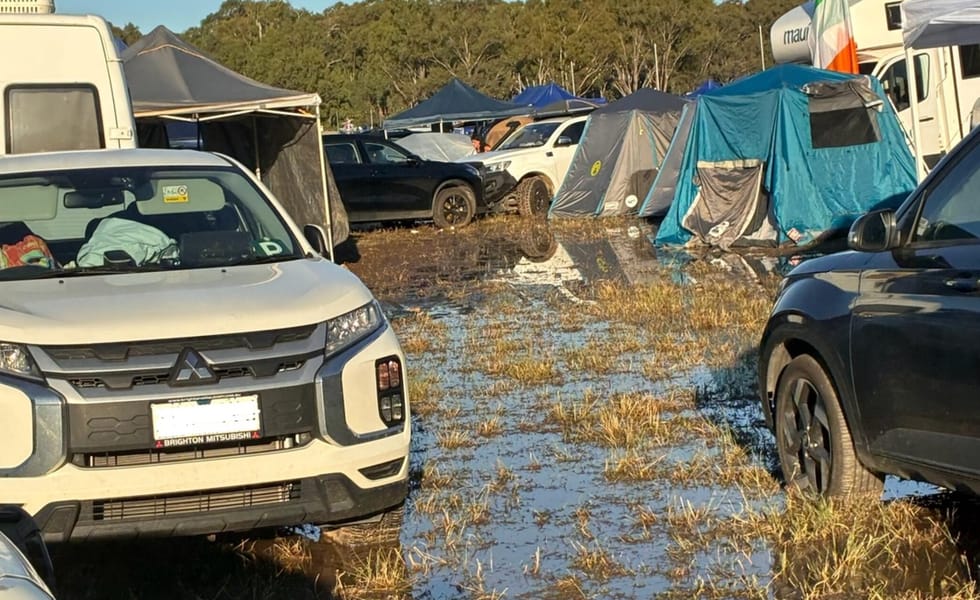
Four people were hospitalised after lightning struck Strawberry Fields on Friday night, illustrating the challenges of providing safe shelter and coordinating emergency responses at outdoor camping festivals.
Two people were holding onto the supports of a temporary shelter at Strawberry Fields on Friday night when lightning struck, according to NSW Ambulance Chief Inspector Bruce Purves, speaking to the Southern Riverina News.
They were among four festivalgoers taken to hospital after thunderstorms swept across the Tocumwal festival grounds, bringing heavy rain, flash flooding and repeated interruptions to performances. All four have since been discharged.
The incident unfolded on the opening day of the sold-out three-day festival, held on the banks of the Murray River near the NSW-Victorian border.
In an official statement issued on November 21 and supplied to BLUNT by Daydream Nation Director Stacey Piggott, Strawberry Fields confirmed that performances had been suspended multiple times between late Friday afternoon and the early hours of Saturday morning.
The organisers confirmed that all four people had sustained non-life-threatening injuries and that their families had been contacted.
“We wish them a speedy recovery and thank our medical teams, emergency services, and staff for their fast response in enacting our severe weather plan,” Strawberry Fields said.
The festival team assessed the site on Saturday morning and was working to support campers affected by the severe weather. Organisers also committed to continuing to monitor conditions in conjunction with relevant agencies.
Normal programming resumed on Saturday.
The Difference Between Staying Dry and Staying Safe
Speaking to the Southern Riverina News, Purves indicated that the injuries appeared to have resulted from contact with objects struck by lightning.
It’s an important distinction when considering the types of shelter available at a camping festival. A structure capable of keeping its occupants dry may offer little protection during an electrical storm.
The Bureau of Meteorology’s severe-weather safety guidance recommends seeking shelter inside a substantial building or enclosed, hard-top vehicle during a thunderstorm. It advises against sheltering in fabric tents or small, open structures.
For camping festivals, where temporary structures are central to both accommodation and event infrastructure, that presents a considerable logistical challenge.
Attendee accounts published by the Southern Riverina News indicate that festivalgoers were directed to remain in vehicles or seek shelter as the storms passed through. One attendee, who spent several hours inside a car, praised the organisers’ response.
In response to BLUNT’s questions about severe-weather procedures, Strawberry Fields said its annual risk assessments and event documentation include provisions for shelter and emergency communications.
The organisers did not specify the types or capacity of lightning-safe shelter available to attendees, particularly those without immediate access to vehicles.
Emergency Response Beyond the Festival Grounds
The storm also brought challenges beyond the immediate threat of lightning. Flash flooding inundated parts of the festival site, leaving tents submerged and access roads difficult to navigate.
Of the four people requiring hospital assessment, one was airlifted to Shepparton Hospital and another transported there by road. Two others were taken to Deniliquin Hospital.
Purves explained that the latter two patients were in a stable condition, allowing emergency services to distribute patients between hospitals and avoid placing additional pressure on Shepparton.
That decision illustrates another consideration for large regional music festivals: emergency planning must account not only for the medical resources available onsite, but also for transport and the capacity of surrounding health services.
Under the NSW Government’s music festival planning requirements, organisers must prepare a Health and Medical Plan. These plans cover matters such as onsite medical services, first aid facilities and consultation with local hospitals and emergency services.
Depending on the event, organisers may also be required to submit their plans to NSW Health for agreement. Emergency management plans may form a separate part of the broader event approval process.
Preparing for the Next Storm
Responding to BLUNT’s enquiries, Strawberry Fields outlined aspects of its emergency planning and communications infrastructure.
“Each year event documentation and risk assessments including our severe weather plan, are reviewed internally and endorsed by all relevant external stakeholders and agencies prior to us opening gates to ensure compliance,” Strawberry Fields said.
An Emergency Response Coordinator operates the festival’s dedicated emergency public address system. According to Strawberry Fields, the system can broadcast messages to individual areas or across the entire site, including campgrounds and stages.
“We also have Helper Huts at each campground to assist with direct communication,” the organisers added.
Strawberry Fields’ publicly available attendee guide also encourages festivalgoers to prepare for a range of weather conditions, including bringing appropriate clothing and camping equipment.
While the organisers outlined their annual review process, they did not indicate whether Friday’s incident would prompt a specific review or changes to future severe-weather procedures. Whether flooding affected emergency access also remains unclear.
The injuries sustained on Friday do not, in themselves, establish that the festival’s emergency arrangements were inadequate. The incident does, however, illustrate the complexity of protecting people at large outdoor events.
Suspending performances and communicating warnings are important components of a severe-weather response, but attendees also need somewhere safe to go, whether they’re in the crowd, at their campsite or travelling between the two.
MORE IN News