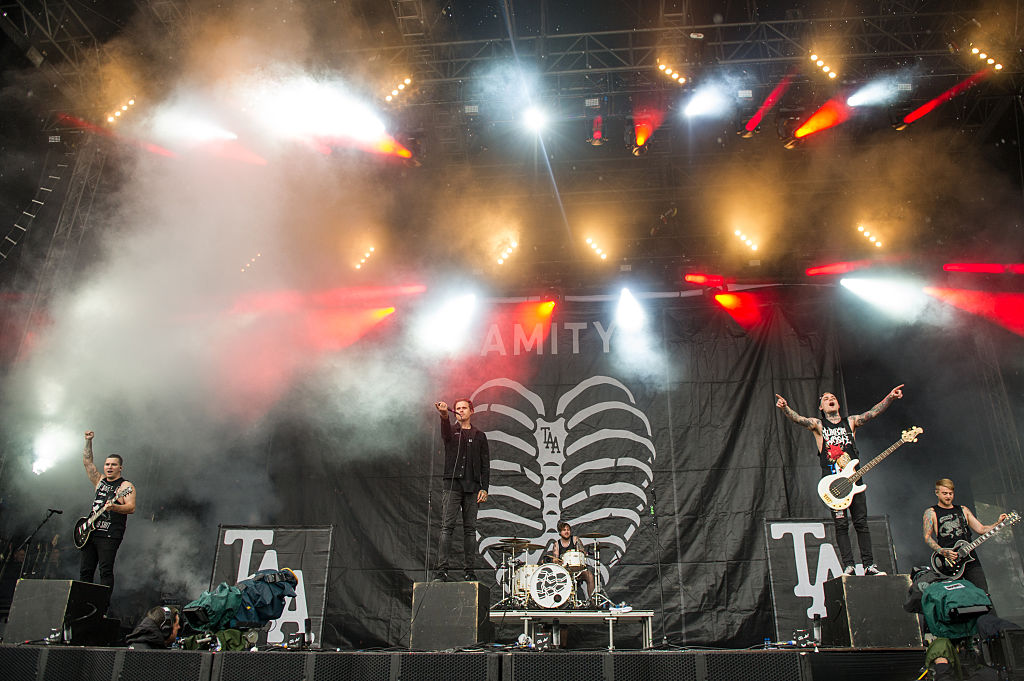
Ahren Stringer has broken his silence on his exit from The Amity Affliction, pushing back on how his departure was portrayed and rejecting claims that he was a drug addict.
In a new interview, Stringer says he was misrepresented publicly as tensions inside the band escalated.
But as his side of the story comes into focus, something else behind the scenes is starting to surface. Corporate filings show the company behind The Amity Affliction quietly entered a formal restructuring process in 2025 to manage close to $650,000 in debt. It meant both Stringer and frontman Joel Birch were still required to work together, even as their relationship broke down.
For fans, the split looked clean. Stringer was out. The band moved on. New music, new shows, a new chapter.
That shift became visible in early 2025. In February, Stringer fired back publicly during the trademark dispute, posting: “Who started the band again? You will lose.” It was the moment everything spilled into the open.
The reality is a lot messier.
At a business level, nothing has actually been untangled yet. Stringer remains a co-owner and director of The Amity Affliction’s company, with the ownership structure unchanged. That means even after being removed from the band, he is still tied to the business that powers it financially and legally.
And that’s where things get complicated.
The restructuring documents show the company was carrying roughly $646,000 in debt, with the majority appearing to be owed to the Australian Taxation Office. Rather than collapsing, the band entered a formal plan to repay around $512,000 over time, roughly 75 cents in the dollar, through future income generated by the band itself.
In simple terms, the business didn’t break, but it came under pressure.
To manage that, both Birch and Stringer signed off on a restructuring plan that will see the company make regular payments over nearly three years. That kind of setup doesn’t suggest a band on the verge of disappearing, but it does suggest one that doesn’t have the flexibility to make big financial moves quickly.

Like paying out a former member.
Behind the scenes, sources indicate there have been ongoing attempts to reach a settlement between the two sides. But with the company servicing debt and still reliant on future revenue, a clean break hasn’t materialised.
That helps explain why everything has dragged out the way it has.
Stringer’s interview now lands differently in that context.
When he talks about burnout from constant touring, it is not just a personal complaint. Touring is the band’s primary source of income. When he says he had no control, despite being a director, it points to a breakdown in how decisions were being made internally. And when he pushes back on how he was labelled publicly, it is not just about reputation. It is about how he is perceived while still tied to the business.
From Joel Birch’s side, the pressure looks just as real.
He has been trying to keep the band moving forward. Releasing music, playing shows, holding onto an audience that strongly associates Stringer with the band’s sound, while also managing a company under financial constraint. That is not just creative pressure. That is operational pressure.
And those two realities do not line up neatly.
Stringer wants out. Birch needs stability. The business sits in the middle.
That is why, more than a year on from the first signs of tension, this still does not feel resolved.
Because it is not.
The Amity Affliction have not just gone through a band breakup. They are in the middle of a business separation that has not been completed. Until it is, both sides remain tied to each other in a structure that does not offer an easy exit.
So what happens next?
There are only a few real options.
A buyout would allow Stringer to walk away completely, but that requires cash the company may not currently have available. The band could continue as-is, with Stringer remaining an owner behind the scenes, but that is a long-term tension that is hard to sustain. Legal escalation is another path, but it is expensive and unpredictable.
Then there is the uncomfortable possibility that some form of alignment, whether creative or purely commercial, becomes the easiest solution.
Not because they want it.
Because the structure might demand it.
For fans, it is a strange place to be. A band that feels split, but is not fully separated. A story that feels finished, but clearly is not.
For the people inside it, it is even more complicated.
This is not a group of teenagers falling out anymore. Birch is now in his mid-40s, Stringer pushing 40, with a business, a legacy, and a livelihood tied up in something that does not have a clean off-switch.
Which is why this story is still unfolding, and why it might not resolve the way anyone expects.
Gallery: Ahren Stringer and Joel Birch in happier times









Watch: Joel Birch ‘I tried to leave the band at the start of 2024’
“Where do I stand financially if I quit the band?”

RELATED




MORE IN Music