Backstage, the final few minutes before a show can look strangely repetitive. A singer disappears into the same corner of the dressing room. A guitarist checks the same piece of gear twice. A band forms a huddle, says the same few words and walks towards the stage in the same order it did the night before.
From the outside, some of these habits look like superstition. From inside a touring schedule, they make a lot more sense.
Live performance is built around variables. The room changes. The crowd changes. Soundchecks run late. Festival sets can happen in daylight one week and in a dark club the next. Even artists who have played hundreds of shows still have to move from ordinary conversation into a highly concentrated performance state on cue.
A ritual gives that transition a shape.
Why Rituals Stick When Everything Else Changes
The useful thing about a pre-show routine is not necessarily what the routine contains. It is that the performer already knows what comes next.
That can be as practical as a vocal warm-up or as arbitrary as wearing the same ring, eating the same meal or listening to the same song. The first category has an obvious physical purpose. The second can still perform a psychological one.
Repeated actions narrow attention. Instead of thinking about the size of the room, the possibility of a mistake or the hundred small things happening backstage, the performer has one familiar sequence to follow.
That is why rituals tend to survive even when artists stop believing there is anything magical about them. The object, phrase or action becomes a cue: this is the part of the day when the outside noise gets quieter and the show begins to feel real.
The Object Is Rarely the Point
Lucky objects are especially easy to mock because their practical value is close to zero. A necklace cannot improve a monitor mix. A particular shirt cannot make an audience more receptive. A coin in a pocket cannot prevent a missed note.
But usefulness is not always the point.
Familiar objects can become attached to familiar states of mind. If an artist has carried the same object through dozens of successful shows, the object starts to belong to the mental landscape of performing. Losing it may feel disruptive for the same reason that changing a long-practised warm-up can feel disruptive: something that normally happens automatically suddenly demands attention.
That does not make the superstition true. It makes the habit real.
For musicians moving through Australian festivals, theatres and clubs, that kind of continuity can be particularly appealing. Touring is a sequence of unfamiliar rooms. A tiny personal ritual is one of the few parts of the environment the performer controls completely.
Band Rituals Work Differently
A group ritual has another job. It does not just settle one person; it synchronises several of them.
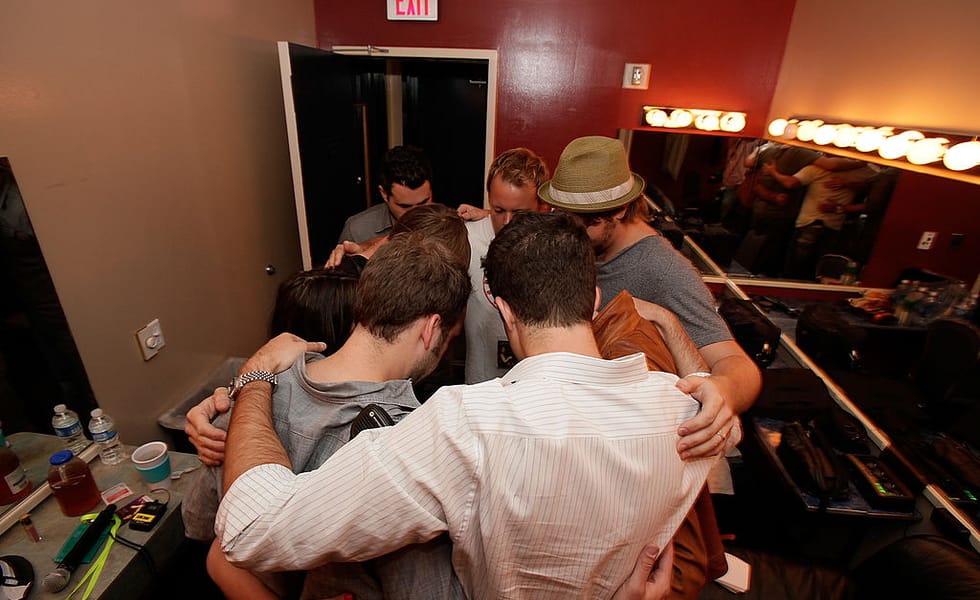
The classic pre-show huddle works because it creates a clear dividing line between the scattered activity of backstage life and the shared concentration of the stage. A chant, handshake, prayer, joke or repeated phrase can do the same thing.
This is closer to a team-sport ritual than an individual superstition. Nobody needs to believe the words have supernatural power. The important part is that everyone recognises the signal.
That signal can also flatten the hierarchy inside a band. For a few seconds, the singer, drummer, touring players and crew members involved in the ritual are participating in the same moment. On a long tour, where fatigue and logistics can make people feel as though they are working parallel jobs, those tiny points of collective routine matter.
When Preparation Starts Looking Like Superstition
The line between preparation and superstition is rarely clean.
Breathing exercises have a physical effect. Stretching hands before playing has an obvious practical purpose. A quiet room can reduce distraction. Repeating a particular sentence to yourself is harder to measure, but it may still help attention settle.
Then there are habits that sit somewhere in the middle. A performer may insist on making tea in the same order every night, not because the order changes the tea but because the sequence marks time. Someone else may walk the same route to side stage simply because doing so has become part of getting ready.
Over time, even practical preparation can acquire ritualistic details that have nothing to do with the original purpose.
That is part of what makes backstage routines interesting. They show how quickly humans turn repetition into meaning.
Repeated Cues Are Everywhere
The same pattern appears well beyond music. People use repeated labels, gestures and visual cues to reduce the amount of information they have to process in the moment. Venues use wristband colours and call times. Apps rely on familiar icons. Commercial websites often compress complicated information into fixed names and phrases; something as specific as the Slotozen bonus on Slotozilla is an example of that kind of promotional shorthand.
The particular label is less interesting than the behaviour around it. Once a cue has been encountered often enough in the same setting, people stop reading it from scratch. They recognise the pattern and understand where it sits within that environment.
Backstage rituals work in similar cognitive territory. A knock on the dressing-room door, a familiar song through a phone speaker or the same final stretch can carry more meaning than the action itself because it has become shorthand for what happens next.
The Famous Habits Are Usually the Small Ones
Stories about musicians’ pre-show habits endure partly because the details are so ordinary.
Keith Richards’ long-reported attachment to being the first person to cut into his shepherd’s pie before Rolling Stones shows is memorable precisely because it is not grand. Robert Plant has spoken about ironing shirts backstage. Rivers Cuomo and Scott Shriner of Weezer have used a Frisbee as part of their pre-show routine.
None of those actions looks like the mythology normally associated with rock performance. That is what makes them believable as routines. They are small jobs that occupy the hands, create a familiar rhythm and give the mind somewhere uncomplicated to sit before the lights go down.
The same is true of quieter habits that never become anecdotes: a singer steaming their voice, a drummer tapping through rudiments, a guitarist restringing an instrument that probably does not need restringing yet.
Rituals survive because repetition is calming, not because musicians are uniquely superstitious.
A Small Piece of Control
The useful distinction is not between rational musicians and irrational ones. Most people rely on rituals when the stakes feel high enough.
The question is what the ritual is doing.
If it helps a performer move from waiting into concentration, creates a sense of continuity inside an unpredictable tour or gives a band a shared cue before stepping onstage, then it has a function even if the individual action is arbitrary.
That is why pre-show rituals remain such a durable part of music culture. A live show can never be completely controlled. The crowd will react however it reacts. Equipment can fail. Adrenaline can arrive at the wrong moment.
A ritual does not remove any of that.
It simply gives the performer one small, predictable thing to do before walking into it.
MORE IN Music