Twenty-seven years after its beginnings in Australian alternative music, BLUNT is preparing its biggest reinvention yet. But understanding where it’s going means remembering why it mattered in the first place.
Before algorithms decided what people should listen to, before every band had a direct line to its audience, and before music journalism became an endless race to report the same announcements, there was a different way to discover alternative culture.
You found it in record stores, at concerts, through friends, and in the pages of magazines that understood your world better than the mainstream ever seemed to.
For a generation of Australian music fans, one of those magazines was BLUNT.
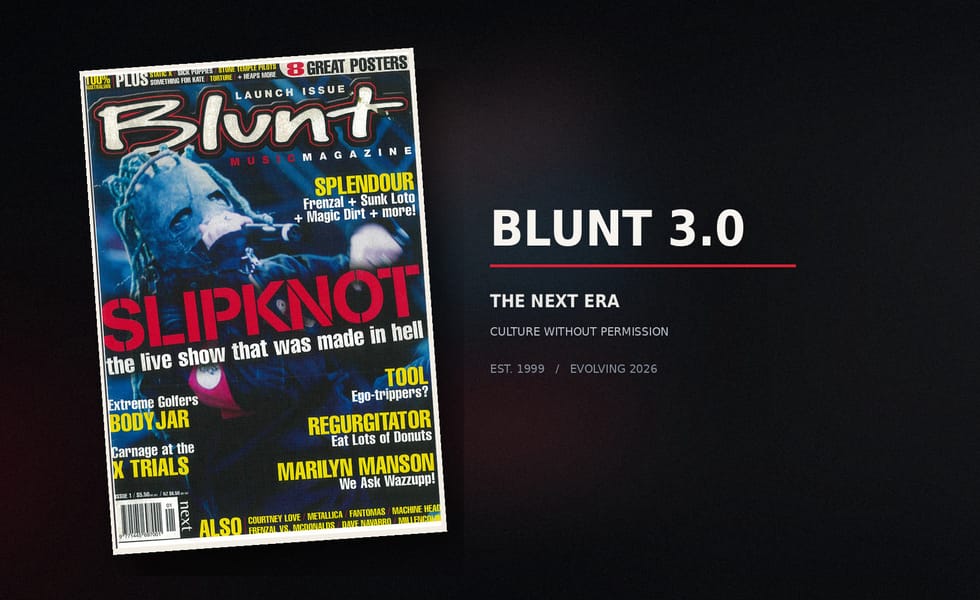
The story began in 1999, when BLUNT launched as a poster magazine. By 2001, it had evolved into a full publication, with Slipknot appearing on the cover of its first issue. Inside, Mark Hughes interviewed Corey Taylor backstage at Ozzfest as the band prepared to unleash Iowa.
It was a fitting beginning for a magazine that would become synonymous with Australian alternative music culture.
Over the following decades, BLUNT became part of the lives of fans growing up with punk, hardcore, metal, emo and alternative rock. Its posters covered bedroom walls. Its interviews introduced artists to new audiences. Its pages documented bands, scenes and subcultures that received considerably less attention from mainstream entertainment media.
But those magazines represented something bigger than music.
For the people who bought them, alternative culture was often about identity, rebellion, creativity, friendship and finding somewhere to belong. The bands mattered because of what they represented as much as the music they made.
BLUNT understood those communities from the inside.
The archive tells the story of that influence. In 2004, BLUNT interviewed Green Day as the band prepared American Idiot. It captured My Chemical Romance during their dramatic rise, and featured Parkway Drive on a 2007 cover when the Byron Bay band was still building the international career that would eventually take it to arenas and festival headline slots around the world.
The publication’s interests also reached beyond music. Its interview with filmmaker Quentin Tarantino reflected an editorial curiosity that was never entirely confined to genre.
The magazine changed along with the industry. Print gave way to digital, ownership changed, and music discovery shifted towards streaming and social media. Nextmedia’s original era eventually gave way to a revival under The Complaints Department in 2020.
In 2024, Joel King acquired BLUNT’s intellectual property and brand assets, beginning another redevelopment of the publication. King, who later stepped down as COO of Vinyl Media, brought years of experience across Australian digital publishing, music media and live entertainment.
The renewed BLUNT began rebuilding its editorial presence while using its existing audience, connected music communities and social platforms to distribute stories far beyond the traditional website readership.
The results demonstrated that an established music publication could still influence cultural conversations in an era dominated by social platforms.
In November 2025, Melbourne provided another demonstration of BLUNT’s evolving editorial approach.
When Amyl and the Sniffers’ free all-ages performance at Federation Square was cancelled following a crowd barrier breach, BLUNT followed the story as it developed.
The band redirected its $35,000 performance fee into bar tabs at seven grassroots venues, turning a cancelled concert into a citywide celebration of Melbourne’s live music community.
The incident unfolded during an extraordinary period for Melbourne rock music, with stadium-scale shows by AC/DC and Metallica drawing enormous attention to the city’s live music culture.
Rather than treating those performances as isolated entertainment events, BLUNT examined the relationship between major shows and the smaller venues and communities that make a thriving music culture possible.
It was an example of finding the story beneath the spectacle.
In December 2025, an unexpected incident at Good Things Festival became one of BLUNT’s biggest stories of the year.
When Garbage frontwoman Shirley Manson confronted a fan over a beach ball during the band’s Melbourne performance, footage spread rapidly online.
BLUNT tracked down the fan, Ben O’Brien, and published an exclusive interview that added his perspective to a controversy already attracting international attention.
The story moved beyond a disagreement at a music festival into a broader discussion about artist-audience relationships, public behaviour and the speed at which viral incidents become cultural battlegrounds.
As BLUNT reported at the time, coverage of the controversy helped drive more than 20 million views across its platforms in three days.
The incident demonstrated the reach that culturally relevant journalism could achieve when original reporting met an audience already deeply engaged in the conversation.
In March 2026, BLUNT’s reporting became part of a much more serious national conversation.
On March 20, King published a report identifying a NSW court matter involving Jed Daniel Gordon, a former merchandise and touring associate of Parkway Drive. The initial article carefully distinguished what could be verified from public records from details that had not yet been independently confirmed.
The following day, Parkway Drive issued a statement confirming that Gordon had pleaded guilty to a sexual offence involving a minor and that his association with the band had ended.
BLUNT continued examining the public record. On March 22, it published archived social media posts confirming that Gordon was the brother of Parkway Drive drummer Ben Gordon, a relationship not mentioned in the band’s initial statement.
The developing story reached wider Australian media, including ABC News, Rolling Stone Australia and The Sydney Morning Herald.
On March 24, Parkway Drive frontman Winston McCall addressed the situation in a video statement, acknowledging the band’s responsibility for employing Gordon, expressing support for the victim and apologising to people who had experienced negative interactions with him.
The reporting demonstrated the importance of following a story beyond its first announcement, documenting new information as it emerged and maintaining careful distinctions between established facts, public statements and allegations.
It also demonstrated that specialist music journalism could contribute to national public-interest reporting.
But BLUNT’s renewed editorial approach hasn’t been exclusively about exposing wrongdoing or challenging powerful industry figures.
In June 2026, the publication published an evidence-led examination of accusations surrounding Yungblud, who had repeatedly been labelled an ‘industry plant’ by critics questioning his authenticity.
King’s article, published through The Blunt Truth series, examined Yungblud’s career history and challenged the assumption that industry support automatically meant an artist had been secretly manufactured.
The distinction was straightforward: having professional backing was not the same thing as falsely presenting a manufactured career as an organic grassroots phenomenon.
The Blunt Truth is BLUNT’s evidence-led series for examining viral culture claims, internet pile-ons and contested narratives. Each review identifies a specific claim, explains its context, checks primary sources and the public record, and separates evidence from assumption. The published method then sets out the reasoning behind a verdict of True, False, Misleading or Unproven, with source trails and pathways for corrections if new evidence emerges. Its purpose is not to amplify a controversy, but to establish what the available evidence actually supports.
Days later, following an emotional performance at BLUDFEST in Czechia, Yungblud quoted the BLUNT headline in a pinned Instagram comment, writing that the article had made him ‘feel happy’.
The interaction was subsequently reported internationally, including by NME.
It was a significant example of a publication’s reporting reaching the person at the centre of a cultural argument.
And it illustrated an important principle: independent journalism should be prepared to challenge an artist when evidence warrants it, but equally prepared to challenge the public when an artist is being unfairly characterised.
The same approach was visible in BLUNT’s coverage of the copyright dispute involving Amyl and the Sniffers frontwoman Amy Taylor and photographer Jamie Nelson. Following the settlement, King scrutinised the public statements made about the outcome and compared those claims with the legal record.
The common thread across these stories wasn’t controversy for its own sake. It was the belief that cultural journalism should examine what happened, question what people are being told, and keep following a story when new evidence emerges.
And that brings BLUNT back to the question that has followed it throughout its history: what exactly is alternative culture?
In 1999, the answer was often associated with the music people listened to, the clothes they wore and the scenes they belonged to.
But underneath those things was something more enduring.
Alternative culture was about questioning expectations, challenging accepted narratives and finding meaningful connections outside established systems.
Those instincts haven’t disappeared.
What has changed is the world in which people experience them.
Artificial intelligence is transforming how information is created and distributed. Algorithms influence what people discover. Social platforms can turn an unknown cultural moment into a global conversation within hours.
There is more content available than at any previous point in history, yet finding something meaningful, credible or genuinely original can feel increasingly difficult.
The environment has changed. The emotional needs haven’t.
People still want authenticity, identity, creativity and connection. They still look for voices that understand their communities and aren’t afraid to question the prevailing narrative.
BLUNT 3.0 is being developed around that continuity.
The ambition is not to abandon alternative music, nor to become a conventional lifestyle publisher covering every subject simply because it attracts an audience.
Instead, BLUNT intends to apply the perspective that defined its original magazine to a much broader cultural landscape.
Music remains central, but the next generation will explore film, gaming, technology, photography, creators, cities and the communities shaping how people live.
Its editorial interests will not be limited to underground movements. Mainstream artists and global cultural phenomena can be just as important when they influence identity, behaviour or public conversation.
The distinction is in the questions BLUNT asks, the people it speaks to, the evidence it examines and the stories it considers worth pursuing.
Sometimes that means finding stories that larger publications haven’t considered important. Other times it means approaching the biggest cultural conversations from a completely different direction.
The goal is not simply to follow culture as it happens, but to contribute original reporting, context and ideas that help shape how people understand it.
One early expression of that ambition is BLUNT.news, already operating as BLUNT’s public-interest journalism arm.
Launched in August 2026, BLUNT.news investigates culturally significant stories that deserve deeper reporting and continued attention. Its first major investigation, What Happened to Providoor?, examined public claims and customer-review records surrounding a food-delivery business that collapsed and later relaunched under different ownership. The platform is designed to distinguish verified facts, contested claims, source material and unanswered questions, updating the public record when significant new evidence emerges.
The approach draws on lessons from the Parkway Drive reporting, The Blunt Truth and other stories that have shown the value of source records, timelines, direct statements and evidence-led follow-through.
It is a way of taking the editorial instincts of an alternative music publication and applying them to issues whose importance reaches beyond any particular entertainment category.
Behind the wider network, technology including AI will help organise information, preserve cultural archives, connect reporting and improve discovery. But the intention is for human editorial judgement, original reporting and accountable voices to remain at the centre of the public experience.
The network is designed to make the work more connected and useful, not merely produce more content.
At the heart of BLUNT 3.0 is a simple ambition: to find meaningful culture in an increasingly artificial world.
The wider network and its first destinations will be introduced next week.
Twenty-seven years after Slipknot appeared on the first cover, BLUNT is preparing to move beyond the boundaries of the music magazine that made its name.
But the thinking behind that move is remarkably familiar.
Alternative was never only a genre. It was a way of looking at the world.
And that perspective has considerably more ground to cover.
Culture Without Permission.
MORE IN Culture