A game title starts working before the loading screen does.
It sits beside the artwork, the trailer thumbnail and the store tile, quietly telling the audience what kind of world may be waiting. A title can suggest menace, comfort, speed, scale or absurdity before anyone knows what the controls feel like.
That is a strange amount of labour for a few words. Dead Space makes an empty room sound hostile. Animal Crossing makes movement feel social rather than dangerous. Football Manager barely bothers with atmosphere because its repeated activity is the whole pitch. Each name approaches the same problem differently: how do you frame an experience before the experience has begun?
The answer is rarely to explain everything. Game titles work because they reveal just enough.
The Title Arrives Before the Rules
Every part of culture has its shorthand. A band name sets a temperature before the first note. A film poster tells us whether to expect romance, dread or spectacle. A game title has to do something similar while carrying an extra problem: it must frame an activity that may still be completely unclear.
“Kingdom”, “war”, “racing”, “island” and “survival” all create different expectations, but they do not carry the same weight. Some words point towards a setting. Some suggest a mood. Others make a firmer claim about what the audience will repeatedly do. The title becomes a small negotiation between atmosphere and information.
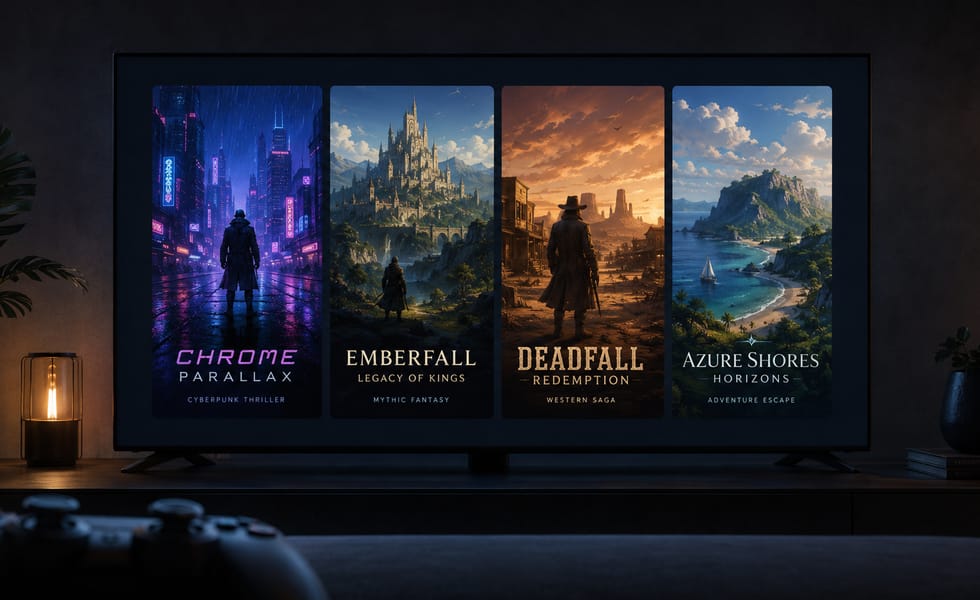
That negotiation matters because game genres are unusually fluid. Game researcher Jesper Juul has noted that genre shapes how games are designed, promoted and understood, even as games freely borrow mechanics from one another. A fantasy world might hold a tactical strategy game, a cosy farming loop, a card battler or a violent action story. A neon city might contain an open-world role-playing game, a driving game or a puzzle. The genre cue narrows the mood without settling the mechanics.
Genre Words Come With Cultural Baggage
Words such as cyberpunk, noir, western and mythic do not begin with games. They arrive carrying decades of books, films, comics, music and visual design. “Cyberpunk” brings rain-slicked streets, surveillance, body modification and corporate power. “Western” suggests dust, distance, outlaws and a particular kind of moral loneliness. A title can borrow all of that history without spelling it out.
This is why a familiar genre word can make an unfamiliar game feel readable. The audience may know nothing about the systems underneath, but it already has a visual and emotional map. That map can be accurate, deliberately misleading or somewhere in between. Either way, it gives the name something to push against.
A Few Words Can Build an Entire World
Place names are especially efficient. “City”, “island”, “valley”, “empire” and “frontier” all imply scale and social structure. Character labels work in a similar way. A ronin is not just a person with a sword; the word carries solitude, discipline and a life outside an established order. A king, thief, drifter or survivor arrives with a story already attached.
The same compression appears in less obvious corners of digital entertainment. One offshore catalogue groups progressive jackpot pokies beneath a single format while names such as Cyberpunk City, Caesar’s Empire and Crystal Waters point towards entirely different moods. Read as language rather than as a menu, the contrast is the interesting part: neon dystopia, imperial spectacle and glossy escape are doing separate cultural jobs before the underlying format has explained anything.
The mechanics may belong to one category. The titles refuse to sound alike.
Mechanical Words Make a Stronger Promise
Some titles are less interested in mystery. “Manager”, “simulator”, “builder”, “racing” and “puzzle” suggest a repeated action rather than a fictional world. They tell the audience what sort of attention will be required: planning, modelling, constructing, steering or solving.
Even these words leave room for interpretation. A simulator can be painstakingly serious or deliberately ridiculous. A racing game can obsess over tyre temperature or turn every corner into a cartoon collision. A city builder can be an economic model, a social sandbox or a machine for making beautiful screenshots. Mechanical language is clearer, but it is never complete.
The strongest titles often combine the two kinds of signal. One word supplies the world; another supplies the activity. The audience gets a setting and a verb, even when the verb is only implied.
Vagueness Can Be Part of the Appeal
Then there are titles that behave more like album names: Control, Inside, Limbo. They do not describe a genre in any clean way. They create a feeling and let the artwork, trailer and conversation around the game fill in the rest.
That vagueness can be useful. A literal title closes possibilities; an evocative one leaves space for curiosity. It can also become more meaningful after the experience. A word that felt abstract on the store page may look painfully precise by the final scene.
The risk is obvious. Mystery can tip into emptiness. A title may sound enormous while the game beneath it feels routine, or promise a mood the design never sustains. The name earns attention, but it cannot carry the entire experience.
The Mechanics Get the Final Word
A title is a cultural promise, not an instruction manual. It can prepare the audience for a world, suggest a role and establish an emotional register. What it cannot prove is whether the movement feels right, whether the systems remain interesting or whether the atmosphere survives beyond the opening hour.
When a game feels coherent, the name and the mechanics begin to reinforce one another. The title stops being packaging and becomes a summary. When they pull apart, the gap is just as revealing. The audience remembers not only what the game was called, but what the name led them to expect.
That is why game titles matter before anyone presses start. They are tiny pieces of cultural architecture, built from familiar words and borrowed associations. They open the door, point towards a world and then step aside.
After that, the game has to earn its name.
MORE IN Gaming