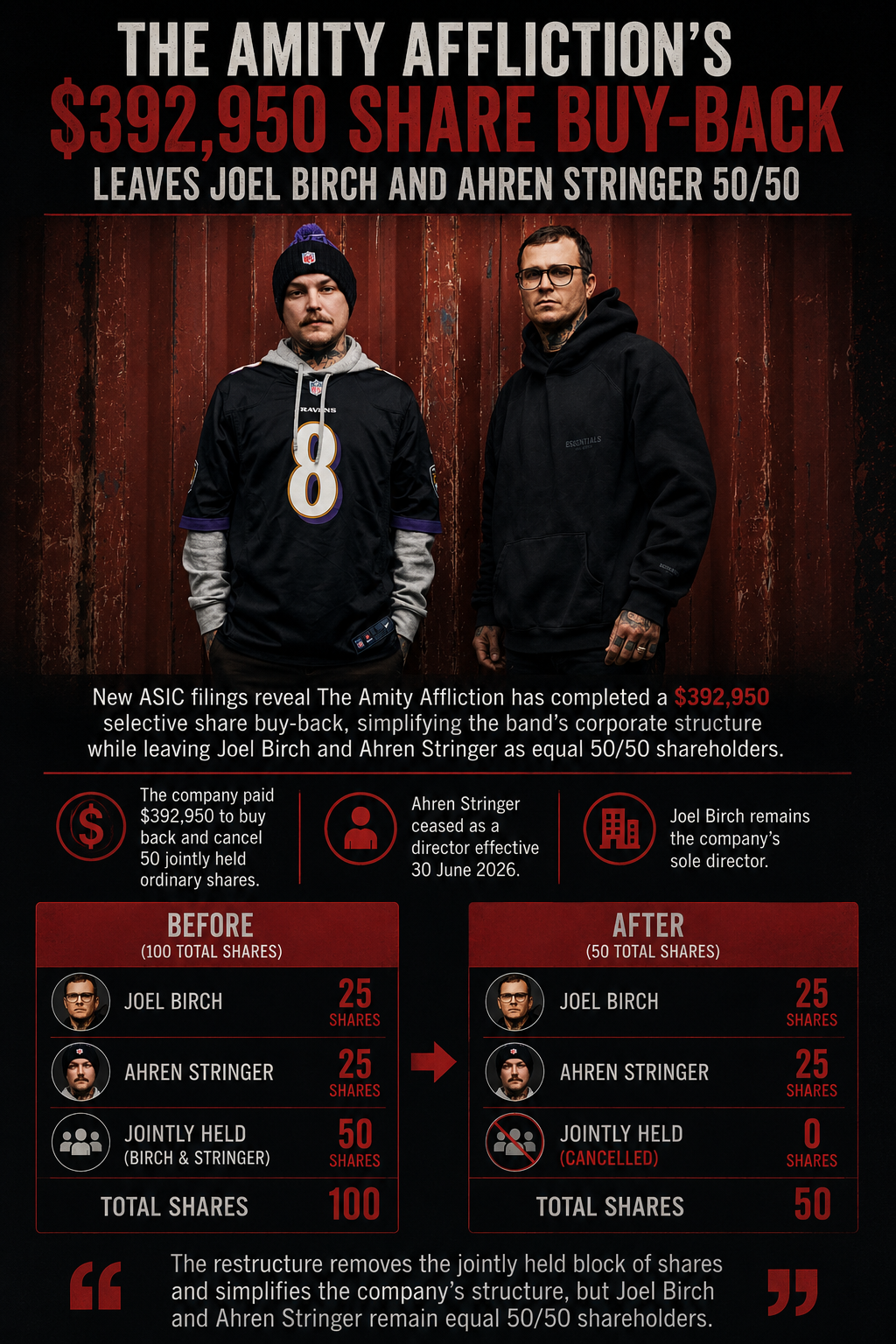
New ASIC filings reveal The Amity Affliction has paid $392,950 to remove half of the company’s shares, simplifying its unusual corporate structure while leaving Joel Birch and Ahren Stringer as equal 50/50 owners.
The Amity Affliction has completed a major corporate restructure, but it has not completed the commercial separation between Joel Birch and former bassist and vocalist Ahren Stringer.
Documents lodged with ASIC show The Amity Affliction Pty Ltd paid $392,950 to buy back and cancel 50 ordinary shares previously held jointly by interests connected to Birch and Stringer.
Before the transaction, the company had 100 ordinary shares.
Joel held 25 shares individually. Ahren held 25 shares individually. Another 50 shares were held jointly.
The company has now bought back and cancelled that joint block, reducing the total number of shares from 100 to 50.
Joel still holds 25 shares. Ahren still holds 25.
In simple terms, ASIC’s current company records show that they now own half the company each.
What actually changed?
The Amity Affliction’s previous ownership structure was unusually complicated.
It was not simply a case of Joel owning one half and Ahren owning the other. Both men had their own individual holdings, while another 50 shares sat in a jointly held block connected to both sides.
That meant half of the company remained tied to both parties, even after Ahren stopped performing with the band.
The $392,950 buy-back removes that jointly held block entirely.
Before the buy-back
- Joel Birch: 25 shares
- Ahren Stringer: 25 shares
- Jointly held: 50 shares
- Total shares: 100
After the buy-back
- Joel Birch: 25 shares
- Ahren Stringer: 25 shares
- Jointly held: zero
- Total shares: 50
The structure is cleaner and easier to understand.
It is also still 50/50.
Ahren is no longer a director
A separate ASIC filing confirms Ahren ceased as a director of The Amity Affliction Pty Ltd effective June 30, 2026.
Joel remains the company’s sole director and secretary.
That distinction matters because being a director and being a shareholder are not the same thing.
A director is responsible for governing and managing a company. A shareholder owns part of it.
Ahren is no longer sitting alongside Joel at director level, which appears to give Joel a much clearer position when it comes to the company’s day-to-day operation.
But Ahren still holds 25 of the remaining 50 ordinary shares.
He may no longer be involved in managing the company, but ASIC’s records show he still owns half of it.
That means the restructure has simplified who runs the company without resolving who ultimately owns it.
This is not Ahren’s full buyout
The filings do not show Ahren being completely bought out of The Amity Affliction.
Instead, the company paid $392,950 to acquire and cancel the jointly held shares while Joel and Ahren retained their separate individual holdings.
The documents do not explain how the $392,950 was divided between the parties.
An equal split may appear logical, but the public filings do not confirm it. The private buy-back agreement may contain different arrangements that are not available through ASIC’s public register.
The filings also do not explain why the buy-back was structured this way.
It may have allowed both sides to access money from the company while removing the awkward jointly held block.
It may also represent the first stage of a longer separation process that could eventually result in Ahren selling his remaining 25 shares.
At this stage, the public documents do not provide enough evidence to say which explanation is correct.
Why “Tranche 1” stands out
One phrase in the buy-back paperwork is difficult to ignore.
The transaction is repeatedly described as the “Tranche 1 Buy-back.”
That wording suggests another stage may have been contemplated when the documents were prepared.
It does not prove that a second buy-back will occur.
There is currently no additional ASIC filing showing Ahren has sold, transferred or agreed to sell his remaining 25 shares.
But referring to this transaction as Tranche 1 leaves open the possibility that the June buy-back was never intended to be the final step.
The debt sitting behind the restructure
The buy-back also lands against the backdrop of the company’s formal debt restructure.
Blunt Magazine reported in March that The Amity Affliction Pty Ltd had entered a restructuring process after accumulating close to $650,000 in debt, with the majority appearing to be owed to the Australian Taxation Office.
The agreed plan involved repaying around $512,000 over nearly three years through income generated by the company.
ASIC’s latest extract continues to list a restructuring plan practitioner connected to the company.
That makes a $392,950 share buy-back a significant financial development.
The buy-back documents state that the company did not need to raise additional funds to complete the transaction and that the payment would not have a material adverse effect on its financial position.
The public documents do not explain where the money came from or how the buy-back sits alongside the company’s ongoing restructuring commitments.
What they do show is that the company found a way to make a substantial payment while continuing to operate and service its broader obligations.
The question Blunt raised in 2025
In February 2025, Blunt examined The Amity Affliction’s ownership structure and explained why Ahren leaving the band did not necessarily mean he had left the business behind it.
The issue was never as simple as one musician walking away from a band.
The Amity Affliction also operates through a company, and Ahren remained tied to that company through its ownership and management structure.
The latest filings finally change part of that picture.
The jointly held block is gone.
Ahren is no longer a director.
Joel appears to have much clearer operational control.
But the larger ownership question remains.
Joel Birch and Ahren Stringer are still equal owners of The Amity Affliction Pty Ltd.
What does this mean for the band?
From a day-to-day perspective, the new structure should be easier to manage.
Joel can continue running the company and the band without Ahren sitting alongside him as a director.
Ahren, meanwhile, retains a major financial interest in whatever happens next.
That matters as The Amity Affliction continues touring, releasing music and building a new era without one of the musicians most closely associated with its sound.
If the band succeeds, the value of Ahren’s remaining stake may rise.
If the ultimate plan is to buy him out, another significant transaction may still be required.
For now, the company has spent $392,950 removing the most complicated part of its ownership structure.
It has not completed the separation.
The Amity Affliction is now easier to operate and easier to understand, but it remains owned equally by two people whose relationships with the band could hardly be more different.

Joel King
Join Joel’s Inner Circle
MORE IN Music