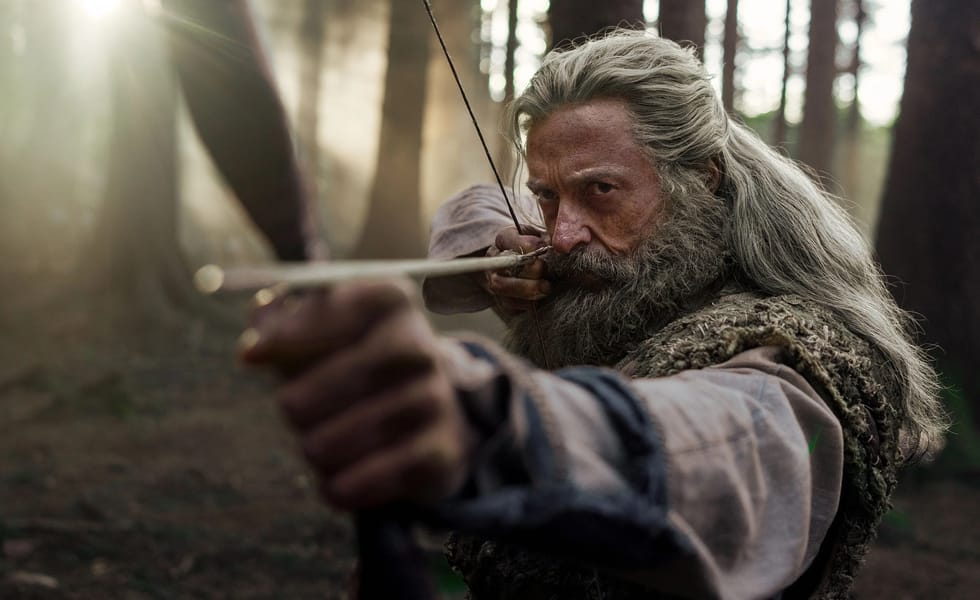
The Death of Robin Hood sees the former Wolverine once again play an aging legend wrestling with his legacy.
They’re calling it Bow-gan, and it’s not hard to see why. A decade on from Logan, Hugh Jackman is once again playing an aged and regretful ostensible hero wrestling with his own legacy and looking, consciously or not, for a quiet grave to moulder in. This time out he’s playing the titular folk hero in The Death of Robin Hood, written and directed by Pig’s Michael Sarnoski, which might be the bleakest take on the merry outlaw yet.
We’ve had dark – or at least darkish – takes on Robin Hood before. Like King Arthur, Robin Hood is a remarkably elastic figure. His legend can encompass Errol Flynn’s Technicolor derring-do, Kevin Costner’s drawling swashbuckler, Disney’s flirty foxes, and Taron Egerton’s Batman-ish vigilante. Ridley Scott’s 2010 Robin Hood with Russell Crowe is one of the grittiest, but it’s not really pushing the envelope – that kind of historical grit was Hollywood standard for period epics at the time, an aesthetic Scott himself popularised with Gladiator. If it’s an influence here, it’s only in a very general sense.
More directly informing Sarnoski here is Richrd Lester’s 1972 film Robin and Marian, which saw Sean Connery as a weathered Robin back from the Crusades and discovering that the world has moved on without him. Given its original title was The Death of Robin Hood, you can guess at how it turns out for him. Funnily enough, Ridley Scott used Robin’s supposed exploits in the Crusades for his take as well, only he used it as an origin story.
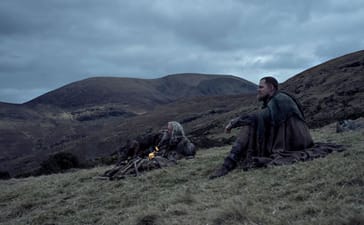
Jackman’s Robin, however, is not a Crusader, and he’s certainly not a hero. When we meet him he’s haggard and near feral, living on the moors like an animal, fearful that old enemies may find him at any moment and subject him to a well-earned reckoning. The first person we see him meet tells him that Robin Hood is a champion of the people; he tells her he was a monster who reveled in murder. He kills her shortly thereafter, and although it’s self-defense, it serves to underline his point.
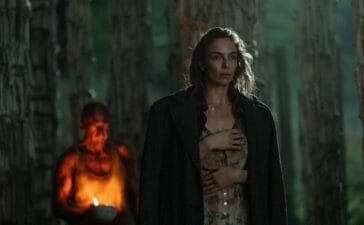
But like Clint in Unforgiven he’s soon drawn back into action, as old comrade Little John (Bill Skarsgård) needs his help on a rescue mission. A bloody massacre ensues, Robin is wounded, and finds himself left at the remote Kirklees Priory to recuperate under the care of the abbess, Sister Brigid (Jodie Comer). There, he gets an inkling that life can be more than butchery and banditry – but perhaps not without cost.
The Death of Robin Hood is a staggeringly bloody and brutal work in places, but only in places. If you want to see Hugh Jackman kill guys in impressively inventive ways – and I understand that appeal, because I feel it too – you’ll get that, but close angles on rabbits being skinned and dressed for the pot are more prominent. This is a Dung Ages take on the medieval period – everything is grim and grey, the landscapes are barrenly beautiful, the mud gets everywhere, the blood stains.
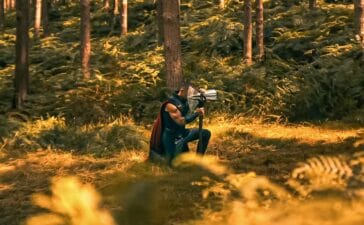
You might take the view that this is a more realistic take on the period, but it’s really more of a willful subversion of previous depictions of Rodin Hood. Besides, realism is in the eye of the beholder; the real Kirklees Priory isn’t on an island, for one thing. For another, there’s the historical provenance of the compound recurve bow that Jackman’s Robin wields, but I’ll leave that debate to more committed history heads (there’s plenty of debate over a “historical” Robin would even have used a longbow – it’s a whole thing).
But Sarnosky’s aim isn’t to present a strictly realistic portrait – almost no filmmaker is, and most of the ones who think they are, are fooling themselves. The bullseye here is a refutation of the legend, and that involves focusing on the sheer, horrific brutality of banditry and its emotional toll on both victims and perpetrators to the exclusion of almost all else.
It’s an interesting enterprise, and that it works is largely down to Jackman’s conflicted performance as the villain protagonist, riven with doubt and self-loathing. Don’t go expecting a cathartic outburst of third act violence to carry you to the credits, either; this is a far more dour affair than even the usual revisionist epic.

The Death of Robin Hood is in cinemas now.
RELATED