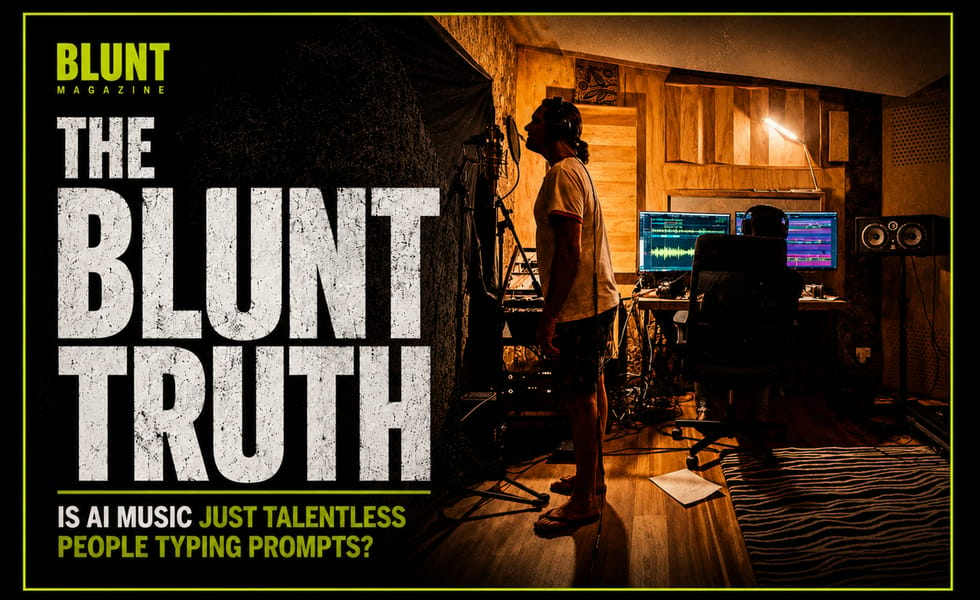
Recent surveys show musicians adopting AI at scale, but stem separation, human-written hybrid production and automated track factories are not the same creative act.
Claim: AI music is simply untalented people entering prompts and pretending they made a song.
Verdict: Misleading.
Part of The Blunt Truth
This article belongs to The Blunt Truth, Blunt Magazine’s evidence-led series reviewing viral culture claims, internet pile-ons and contested narratives.
“AI music is just talentless people typing prompts” is a powerful internet line because it contains enough truth to travel.
Some people do enter a short instruction, accept the first result and publish it. Some operations are building systems that can generate vast catalogues with minimal human review. Voice imitation, unlicensed copying, royalty dilution and streaming manipulation are real problems.
Then the argument gets stretched across everything else.
A producer separating stems is grouped with a streaming spam operation. A songwriter developing one original song through 200 production passes is grouped with a program generating 200 finished tracks from one instruction. A young videographer creating background music for a low-budget scene is treated as though they falsely claimed to be a recording artist.
The phrase “AI music” now covers so many different practices that it often tells us almost nothing about how the music was made.
The Blunt Truth
What the evidence actually supports
Claim: AI music is just talentless people typing prompts.
The Blunt Truth: Misleading
Some AI music is created from a short prompt with little human involvement. Automated systems can also generate and upload tracks at industrial scale.
But the claim becomes misleading when it is applied to every AI-assisted musician. The evidence shows artists using AI for stem separation, restoration, practice, mixing, arrangement and iterative production. Some songwriters begin with a complete original composition, then direct hundreds of generations, replace stems, overdub performances and finish the recording themselves.
The technology alone does not tell us how much human creativity shaped the result.
The criticism accurately describes some minimally directed and automated uses. It does not accurately describe the full spectrum of music now grouped under the label “AI music”.
Musicians are already using AI at scale
The public debate often treats AI as an external force being imposed on musicians by people who cannot write, perform or produce. Recent research paints a more complicated picture.
A Water & Music survey conducted for Moises found that 67% of its 1,525 respondents had used AI for music-related work in the previous year. Among the professional subgroup, that figure reached 78%, compared with 60% of hobbyists.
LANDR reported still higher adoption inside its own creator community. In a 2025 survey of 1,241 music makers, 87% said they used AI somewhere in their workflow. Sixty-nine per cent said they were using more AI tools than a year earlier.
Those numbers require prominent qualifications. Roughly 80% of the Moises sample was recruited through Moises, while LANDR surveyed its own digitally engaged community. Neither result is a global census of every musician.
Broader rights-organisation and creator surveys have generally produced lower numbers. APRA AMCOS found that 38% of more than 4,200 Australian and New Zealand members had used AI in their work in 2024. Teosto reported 47% among 1,108 Finnish music-industry respondents in early 2025. SGAE reported 34% among Spanish music creators later that year.
The studies use different populations and definitions, so they cannot be plotted as a clean growth curve. But the direction is hard to miss: AI use is substantial, and technology-forward music communities report particularly high adoption.
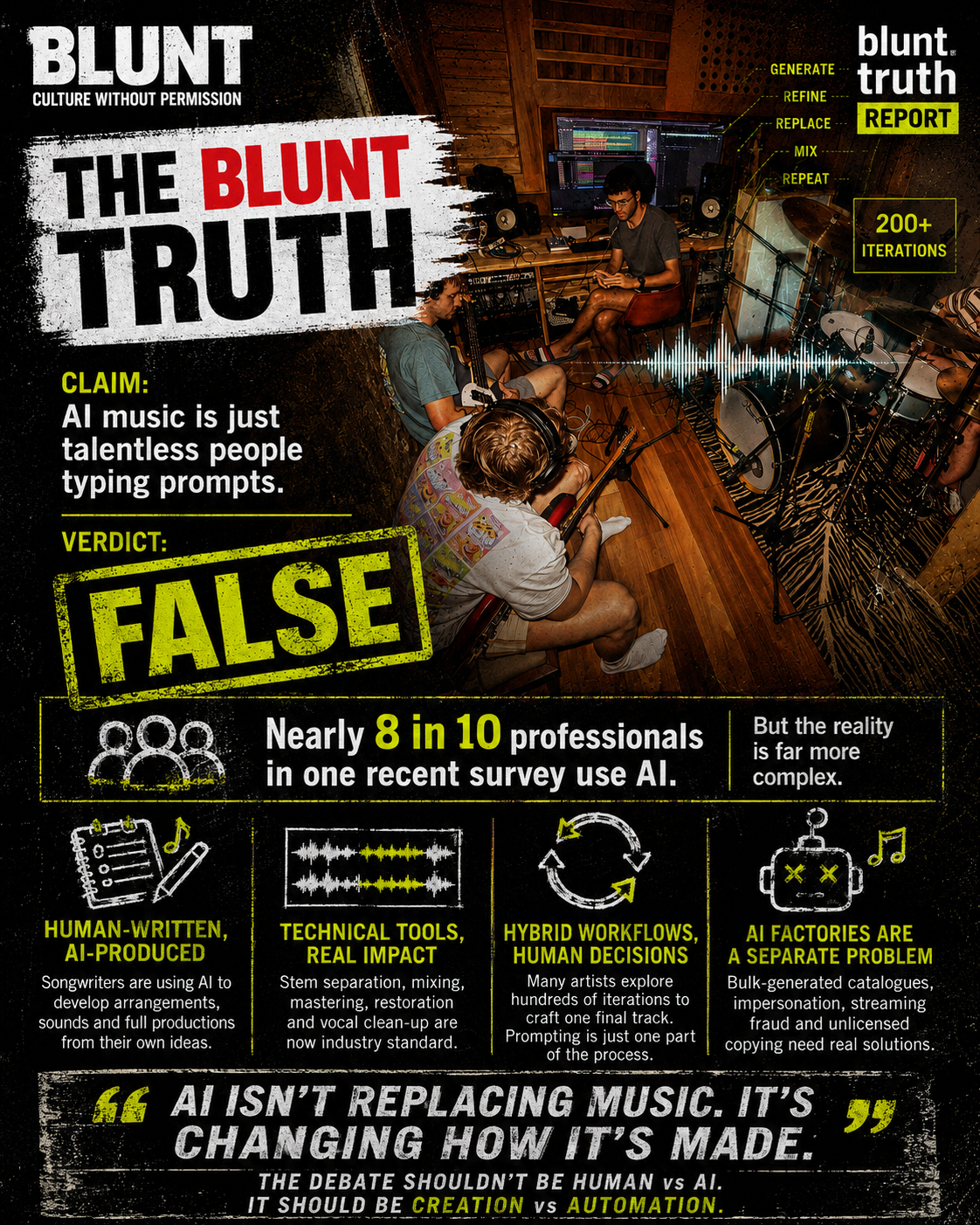
Nearly 8 in 10 professional musicians surveyed use AI. The real question is how.
Recent studies suggest AI adoption is accelerating across music-making. But “using AI” can mean anything from stem separation and iterative production of a human-written song to full-song generation and automated track factories.
Important: these results describe particular survey samples. They do not mean 78% or 87% of every musician worldwide uses AI.
Survey snapshots, not a single trend line
The studies below surveyed different groups and used different definitions of AI. The results should not be treated as one clean longitudinal series—but together they show how quickly AI has entered music workflows.
were using more AI tools than a year earlier
LANDR community survey, late 2025
of that expanding-use group expected to increase use again
Direct evidence of momentum rather than a simple comparison between unrelated surveys
Figures are self-reported. Platform-community samples are likely more technologically engaged than musicians as a whole.
“Using AI” does not mean AI wrote the song
The headline percentages become misleading when they are separated from the underlying tasks.
A musician using AI might be removing noise, separating a vocal, generating a practice accompaniment, testing an instrument sound, creating backing harmonies from an original performance, using an intelligent mastering assistant or exploring arrangements around a song they already wrote.
At the other end, the system might generate the lyrics, melody, harmony, performance and production from a short instruction. Beyond that sits automated volume: code producing tracks, metadata and uploads with little meaningful review.
Those activities do not involve the same level of human authorship, control or intent.
A songwriter who writes the lyrics, melody, chords and structure before opening an AI tool has already created the song’s expressive core. They may then record a complete demo and ask a generative system to interpret it through different instruments, arrangements or production styles.
They may listen to ten versions, change the prompt, alter the source recording, regenerate one section, split the result into stems, remove parts, add new performances and begin again. A single track may pass through 200 directed generations before the production is resolved.
Describing that process as “typing a prompt and receiving a song” is inaccurate. A more useful description is human-written, generatively produced and human-finished.
The system may still contribute arrangements, instrumental performances, textures and unexpected musical ideas. Honest credit should not erase those contributions. But neither should it erase the human lyrics, melody, source performance, repeated decisions, editing, overdubs and final mix.
“Using AI” covers radically different workflows
The adoption headline only becomes meaningful once the tasks are separated. Technical production, creative assistance, full-song generation and automated bulk output are not the same thing.
LANDR: 87% used AI somewhere—but only 13% used an entire generated track
LANDR community survey, n=1,241. Categories overlap.
The survey does not reveal how much prompting, editing, source audio, re-recording or post-production was involved in the song-generator categories.
Moises: 67% overall, 78% among professionals
Water & Music / Moises, n=1,525; roughly 80% recruited through Moises.
All respondents
Confirmed AI use for music-related work in the previous year.
Professionals
Higher reported adoption than the hobbyist group.
Hobbyists
Still a clear majority in this technology-forward sample.
Tasks among confirmed AI users
The survey still misses an important hybrid workflow
A songwriter can write and record a complete original song, upload it, direct dozens or hundreds of production passes, change stems, regenerate sections, overdub and mix. That is not accurately described as either stem separation or a complete song from a text prompt.
The detailed task percentages use confirmed AI users (n=1,021), not the complete 1,525-person sample.
A prompt can mean almost anything
The word itself makes the process sound more uniform than it is.
Sometimes prompting means entering a sentence and accepting the result. In a hybrid workflow, a prompt may be only one instruction among source audio, revised performances, structural edits, selected stems, regenerated sections and feedback based on dozens of rejected attempts.
A person generating 100 finished songs from one automated instruction is not doing the same thing as a songwriter testing 100 possible productions of one original composition.
The first is manufacturing volume. The second is using iteration to realise a specific work.
Two hundred prompts do not automatically make something good. Recording 200 vocal takes does not guarantee a great vocal either. The relevant point is not the number of attempts by itself; it is what the person originated, how specifically they directed the process and what they changed before release.
AI lowers production barriers. It does not manufacture taste
Generative music tools can perform work that once required expensive software, session musicians, an engineer, a producer and access to a professional studio.
That will disrupt parts of the industry. It can also allow a songwriter with strong lyrics and melodies—but limited money or technical production skills—to hear a complete version of a song on the day it is written.
That does not make every user a great artist.
AI can generate polished arrangements, convincing performances and familiar structures. It cannot guarantee that someone has anything meaningful to say. It cannot automatically supply emotional insight, cultural perspective, judgment or a distinctive body of work.
The reduction of technical barriers will produce excellent work from strong creators and enormous amounts of competent but forgettable material from people generating without direction.
Production is becoming easier. Taste remains scarce.
Not every generated asset replaced a commission
The debate also assumes that every generated asset represents income taken directly from a human creator. That is not always the realistic counterfactual.
Consider a young videographer making a low-budget project. They need 30 seconds of background music fitted to the rhythm and tone of a scene. They were never going to commission a composer or license an expensive commercial recording. Their alternatives were a generic royalty-free track, music bundled with editing software or no score at all.
A generative tool might help that person complete their own creative work without claiming to be a musical artist.
Later, the same filmmaker may make a larger project that needs a score capable of genuinely moving an audience. They may commission a composer or license an existing song because the stakes and budget are different.
The same logic applies to a journalist generating a disposable image for a social post rather than using stock photography or a simple text tile. It does not follow that a designer lost a commission that otherwise existed.
That does not mean the aggregate economic effect is zero. Millions of apparently marginal substitutions can reduce demand for production libraries, demo singers, illustrators and entry-level creative services.
Sometimes AI replaces a commission. Sometimes it replaces stock, silence or a project that would never have been completed. A serious argument has to hold both ideas at once.
Curation is creative—but the credit should be accurate
Between traditional songwriting and automated generation sits another growing category: continuous ambient, chill, focus and meditation channels built around generative music.
The operator may not have composed each melody or performed each instrument. But some spend considerable time developing a sound, refining instrumentation and atmosphere, rejecting unsuitable outputs, sequencing material and maintaining a recognisable world across the channel.
That is creative direction and curation.
It should not automatically be presented as conventional songwriting. Someone who did not compose or perform every track should not imply that they did. But dismissing the process as nothing also ignores the value of taste, selection and world-building.
The accurate claim may be: the music is predominantly generated, while its sound, filtering, sequencing and presentation are human-directed.
Automated track factories are a separate problem
At the furthest end of the spectrum are systems capable of generating large numbers of tracks, assigning metadata and uploading them with minimal review.
This is less a dispute about artistic legitimacy than a platform-integrity problem.
When production and distribution cost almost nothing, streaming services can be flooded with synthetic material built to occupy search results, functional playlists and recommendation systems. Some may attract real listeners. Some may be linked to artificial streaming. Much of it may exist because there is almost no cost to manufacturing it.
That is radically different from a songwriter spending days refining one release. Using the worst industrial behaviour to condemn every individual application is intellectually lazy. Using responsible, human-led examples to deny the industrial problem is equally dishonest.
A more useful classification than “AI music”
As AI becomes embedded across production software, a binary label tells listeners less and less. The more useful test is who wrote the music, who shaped the result and how the output was deployed.
Who wrote it?
Who originated the lyrics, melody, harmony, structure and core musical ideas?
Who shaped it?
How much direction, auditioning, selection, editing, performance, arranging and mixing followed?
How was it deployed?
Was one considered work developed—or were hundreds of tracks generated and uploaded automatically?
Five very different things currently called “AI music”
Human-written, AI-produced
A complete human song is explored through generated arrangements, performances and production, often across many iterations.
Hybrid co-creation
Human and model ideas reshape one another during writing, arranging and production.
AI-generated, human-curated
The model creates most of the music; a person develops a sound, filters results, sequences material and builds a channel.
Minimal prompt generation
A brief instruction produces most of a finished track, with limited revision or control over musical detail.
Automated bulk output
Large numbers of tracks and metadata are generated and uploaded programmatically with little meaningful review.
The useful divide is not human music versus AI music.
It is meaningful human expression versus automated volume; consent versus exploitation; creative direction versus deceptive attribution. The technology alone tells us very little about what the person contributed.
Australia is drawing a harder copyright line
The copyright argument is especially current in Australia.
In October 2025, the federal government ruled out a broad text-and-data-mining exception that would have allowed AI developers to use creators’ works without permission or payment. In July 2026, it publicly reaffirmed that Australian writers, musicians, artists and journalists should retain ownership and control of their work, including control over its value.
That does not mean every practical question has been solved. Australia is still working through lawful licensing, the treatment of AI-generated outputs and ways to enforce rights without forcing individual creators into ruinously expensive litigation.
The training debate is more complicated than either side usually admits.
Musicians have always absorbed influence from existing music. Genres are built from shared conventions: rhythms, chord movements, production techniques, vocal approaches and instrumental sounds. Copyright does not normally grant ownership over every broad idea or influence associated with an artist.
But industrial model training is not perfectly equivalent to a musician hearing records. It may involve copying and processing millions of complete digital works at enormous scale, while the resulting system can generate competing material instantly.
The useful legal questions are therefore more specific: how was the training material acquired, was it licensed, can the system reproduce protected expression, does the output imitate a real person’s identity, and who bears the economic effect?
“Every act of training is theft” is too blunt. “Training is no different from listening” is too convenient.
Even the artists’ letter was not a promise to reject every AI tool
The 2024 open letter signed by Billie Eilish, Nicki Minaj, Pearl Jam, Metro Boomin and more than 200 other artists is often described as an anti-AI statement.
It was more specific than that.
The Artist Rights Alliance called for an end to predatory uses that infringe artists’ rights, imitate identities, replace human work or deny fair compensation. The letter also acknowledged that responsible AI could advance human creativity.
An artist can therefore oppose an unlicensed clone of their voice while using stem separation, restoration or a consent-based generative production system. The apparent hypocrisy exists only when every AI use is treated as the same act.
Verdict: Misleading
The claim that AI music is simply talentless people typing prompts contains a fragment of truth.
Some users enter short instructions and publish what appears. Some operations manufacture music at industrial scale. Some people deliberately blur the difference between traditional musicianship and generated output. Some AI companies still face serious questions around permission, training and compensation.
But applying that description to every AI-assisted musician creates a distorted record.
A songwriter who writes and records a complete composition, explores hundreds of arrangements, changes source material, regenerates individual sections, separates stems, replaces performances, overdubs and mixes the final result is not doing the same thing as a program producing 1,000 tracks from one automated instruction.
A curator developing a coherent generative channel may not be a traditional composer, but may still exercise real taste and direction. A videographer generating functional background music is not necessarily pretending to be a recording artist or replacing a commission that would otherwise have existed.
The technology alone does not establish whether a work is thoughtful, empty, exploitative, original or culturally valuable.
The useful questions are who wrote the music, who shaped the finished result, whether consent and attribution were respected, and whether the system was used to realise an idea or simply manufacture volume.
That is the distinction the current debate keeps missing.
Questions readers are actually asking
AI music: the useful answers
The label is broad. These answers separate authorship, production, disclosure, economics and copyright rather than treating every use as the same act.
Does using AI mean AI wrote the song?
No. A songwriter may have written the lyrics, melody, chords and structure before using AI to explore arrangements, sounds or performances. In other cases, the model may originate most of the song. “Used AI” does not answer the authorship question.
How many musicians are using AI?
There is no global census. Broad creator surveys have reported roughly one-third to nearly one-half using AI, while recent surveys of digitally engaged music communities found 67% to 87%. One 2026 report found 78% among its professional subgroup, but about 80% of the overall sample came through Moises.
Is 200 prompts more creative than one prompt?
Not automatically. Effort alone does not prove authorship or quality. But 200 directed generations around a human-written song—combined with revised source audio, stem replacement, editing, overdubs and mixing—is a different creative process from programmatically generating 200 finished tracks and uploading them untouched.
Is a generative chill channel creative?
It can involve genuine taste, sound design, selection, sequencing and art direction. That does not necessarily make the operator the traditional composer or performer of every track. The accurate credit may be curator, producer or creative director.
Does AI always replace a paid musician or designer?
No. Sometimes the realistic alternative was stock music, a royalty-free image, silence or abandoning the project. But millions of small substitutions can still reduce demand for production libraries, demo singers, illustrators and entry-level creative work. Both realities can be true.
Is AI training the same as a musician being influenced?
The analogy identifies something real: culture develops through influence, and broad styles or techniques are not normally owned. But industrial training can involve copying and processing complete works at enormous scale. Training inputs, reproduced outputs and voice or identity imitation are related but separate legal questions.
What should an artist disclose?
Disclosure should focus on material creative contribution: whether the underlying song was human-written, whether central performances or vocals were generated, whether a real person’s identity was imitated, and whether the released master is substantially generated. Listing every invisible technical assistant would quickly become meaningless.
Are artists hypocrites if they criticise AI and later use it?
Not necessarily. The 2024 Artist Rights Alliance letter targeted predatory use, unauthorised imitation, replacement and denied compensation; it also acknowledged responsible uses. Opposing an unlicensed voice clone is compatible with using restoration, stem separation or a consent-based production tool.
The Blunt Report
The evidence record behind this verdict: survey samples, definitions, limitations, disclosure risk and the current Australian copyright position. This module is designed to be updated when stronger data appears.
There is no reliable global percentage for all musicians. The strongest honest conclusion is that broad creator surveys report substantial adoption, while recent technology-platform samples report much higher use. Complete-song prompting remains a smaller category than “any AI somewhere in the workflow”.
Survey record
TuneCore / Believe
- Date
- July 2023
- Sample
- Nearly 1,600 independent, self-releasing artists
- Result
- 27% had used AI music tools
PRS for Music
- Date
- August 2023
- Sample
- More than 1,400 members
- Result
- About 29% used AI for music-related activity
GEMA / SACEM
- Date
- October–November 2023
- Sample
- 15,073 members in Germany and France
- Result
- 35% had used AI in music or creation
APRA AMCOS
- Date
- May–June 2024
- Sample
- 4,274 Australian and New Zealand members
- Result
- 38% had used AI in their work
Teosto
- Date
- December 2024–January 2025
- Sample
- 1,108 Finnish music-industry respondents
- Result
- 47% had used AI in some form
SGAE / CISAC
- Date
- Published September 2025
- Sample
- 1,257 music creators in Spain
- Result
- 34% had used AI; another 17% intended to
LANDR
- Date
- September–October 2025
- Sample
- 1,241 music makers from LANDR’s community
- Result
- 87% used AI somewhere; 69% used more than a year earlier
Water & Music / Moises
- Date
- Fielded November–December 2025; published March 2026
- Sample
- 1,525 musicians; roughly 80% recruited through Moises
- Result
- 67% overall; 78% professionals; 60% hobbyists
Pirate Studios
- Date
- Published November 2023
- Sample
- 1,141 artists across the UK, US and Germany
- Result
- Only 48% said they would tell listeners AI was involved
How to read the figures
Different populations
Rights-society members, independent artists and users of AI-enabled music platforms are not interchangeable populations. LANDR and Moises samples are likely more technology-forward.
Different definitions
Some studies count marketing, artwork, mastering and stem separation; others focus more narrowly on generative composition. “Any AI” is not the same measure as “AI wrote a complete song”.
Possible underreporting
Stigma may suppress public disclosure, and some musicians may not recognise embedded production tools as AI. However, no study reviewed here provides a reliable numerical correction for hidden use.
Self-reported use
The figures depend on respondents understanding and accurately reporting their own workflows. They do not audit released tracks, session files or collaborators’ tools.
Australia: the current copyright position
In October 2025, the Australian Government ruled out a broad text-and-data-mining exception that would allow AI developers to use creators’ work without permission or payment. In July 2026, the government publicly reaffirmed that Australian creators should retain ownership, control and the ability to set the value of their work.
That is a policy direction, not a completed solution. Work continues on lawful licensing, AI-generated outputs and lower-cost enforcement. Sources: October 2025 announcement and July 2026 interview.
Record updated: 18 July 2026. The Blunt Truth gives greatest weight to primary sources, direct statements, public records and clearly attributed reporting. New evidence may lead to an updated record or revised verdict under Blunt’s corrections process.
Joel King
Join Joel’s Inner Circle
MORE IN Music