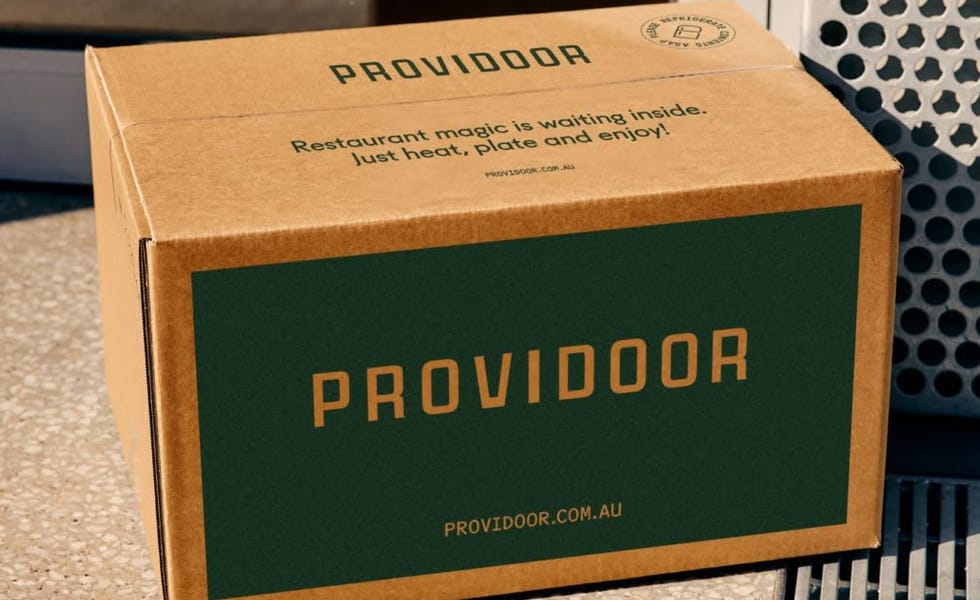
Ready-made meals now sit somewhere between convenience food and restaurant dining. Customers are being asked to trust not just the chef on the box, but the star rating beside it.
That is what made Providoor worth looking at.
Providoor became one of the defining food businesses of lockdown, delivering meals from some of Australia’s best-known restaurants and chefs to suburban front doors. The original company collapsed in April 2023. Six months later, the Providoor brand relaunched under new ownership and a different operating model built around prepared meals.
The story became more consequential when former Providoor CEO Luke Girgis began using his time at the company as evidence behind his new management book, Death to the Org Chart, and the Operationalise consulting method connected to it.
Girgis says Providoor was losing approximately A$400,000 a month, had more than 30 staff, eventually reached breakeven with three staff, kept revenue broadly flat, improved its food and achieved an “all-time high” in customer satisfaction.
If company records support that account, it is an extraordinary turnaround.
BLUNT started checking the record.
The same reviews, two very different pictures
BLUNT analysed 1,500 Reviews.io records and 2,248 Okendo records associated with Providoor.
Within the Okendo export were 1,196 company-level records whose product field was simply “Providoor”. Every one of those records matched a Reviews.io review using the exact timestamp, down to the second, and the same rating.
That meant this was not simply a comparison between two unrelated groups of reviewers. The captured company-level Okendo data was a subset of the Reviews.io record.
The composition of that subset was striking.
After the relaunched Providoor began trading, Reviews.io contained 78 one-star reviews and 75 two-star reviews. None appeared in the captured company-level Okendo set.
By comparison, that same matched set contained 128 of the 142 four-star reviews and 355 of the 381 five-star reviews.
Around Christmas 2024, the difference became even clearer. Reviews.io averaged 3.67 stars in November, 3.19 in December and 2.76 in January 2025. The matched company-level Okendo subset averaged 4.80, 4.92 and 4.44 across those same months.
Across December and January, Reviews.io contained 68 reviews averaging about 2.93 stars. Thirty-four were one- or two-star reviews. Not one of those 34 low-rated reviews appeared in the matched company-level Okendo data.
The broader customer-review average was falling. The captured company-level review set remained dramatically more positive.
Review platforms can be curated
BLUNT also checked how Okendo works.
Okendo’s own moderation documentation says merchants can publish or reject reviews, leave them pending and configure automated publication rules. Its moderation interface separates reviews into pending, published and rejected states.
That means the review set a customer sees on a merchant’s site does not necessarily have to represent every review submitted or imported into the system.
This does not prove Providoor deliberately suppressed negative reviews. BLUNT’s captured export does not contain the administrative audit trail needed to establish who made individual moderation decisions, which settings were used or why.
What BLUNT can establish is the resulting pattern: none of the broader record’s one- or two-star reviews appeared in the matched company-level set, while almost all of its four- and five-star reviews did.
For consumers comparing ready-made meal brands, that raises a simple question: are you seeing the full customer record, or a curated version of it?
The ACCC says businesses may mislead consumers if they suppress or edit negative reviews or remove genuine negative reviews, and says businesses and review platforms should clearly disclose their policies for publishing, editing and removing reviews.
BLUNT is not concluding that Providoor breached Australian Consumer Law. The dataset does not establish the conduct, actor or intent required for that conclusion. The ACCC guidance explains why transparency around review moderation matters.
Click the image to read the full BLUNT.news investigation.
Almost half the review history came from the old Providoor
There was another complication.
Of the 1,500 Reviews.io records analysed by BLUNT, 723, or 48.2 per cent, were written before the current Providoor launched in October 2023.
Those older reviews averaged approximately 4.76 stars. Reviews posted after the relaunch averaged approximately 3.87.
That does not automatically make the older reviews irrelevant. Customers may reasonably care about the history attached to a brand.
But Providoor itself draws a sharp distinction between the old and new businesses when discussing liabilities such as old vouchers, describing the relaunched operation as a completely new company with a different business model.
For a customer looking at one large review total, that corporate break is much harder to see.
Then Providoor promoted 1,530 reviews at 4.6 stars
In March 2026, the Providoor Editorial Team published an article titled Providoor Review 2026: 1,530 Reviews. Is It Worth It?
The article promoted 1,530 reviews averaging 4.6 stars and said that the volume of feedback accumulated over years of operation indicated that “the product works”.
BLUNT could not reproduce the 4.6-star figure from the 1,500 Reviews.io records it analysed. Their simple arithmetic average was approximately 4.30.
Even if the additional 30 reviews required to reach 1,530 were all perfect five-star ratings, the combined average would be approximately 4.31.
There may be an ordinary explanation. The calculation could use a different review universe, combine company and individual-product reviews, apply platform-specific weighting or exclude records under a stated methodology.
Providoor has not publicly identified the source set or calculation.
The page later stopped appearing at its original address
BLUNT archived the March article while it was live on 20 August 2026.
BLUNT subsequently asked Providoor to explain the source and calculation behind the 1,530-review, 4.6-star figure.
By the early hours of 22 August, the March article was no longer being served at its original URL. The address returned a permanent Shopify 301 redirect to a different Providoor review article published in February.
The March article was also absent from Providoor’s current sitemap and blog feed.
BLUNT has not established precisely when the redirect was created, who or what created it, why it was introduced or whether the change was connected to BLUNT’s enquiry.
Providoor was asked to explain the change and whether it continued to stand by the 1,530-review, 4.6-star claim. No substantive response was received by the publication deadline.
The full investigation goes further
The review data is only one part of the story.
The full BLUNT.news investigation examines what Providoor became after the 2023 relaunch, the claimed A$400,000-a-month turnaround, the “30 staff to three” story, the company’s public workforce chronology, the review history inherited from the old Providoor, the economics behind Girgis’s Brag Media sale narrative and his current description of himself as a co-founder of Rolling Stone and Variety Australia.
The public evidence does not establish that the Providoor turnaround was invented. It does show that several of the cleanest claims now being used as evidence of business expertise become considerably more complicated when checked against the underlying record.
The bigger question is simple: when extraordinary business results become the proof used to sell expertise, how closely should the underlying record match the story being marketed?
MORE IN Culture