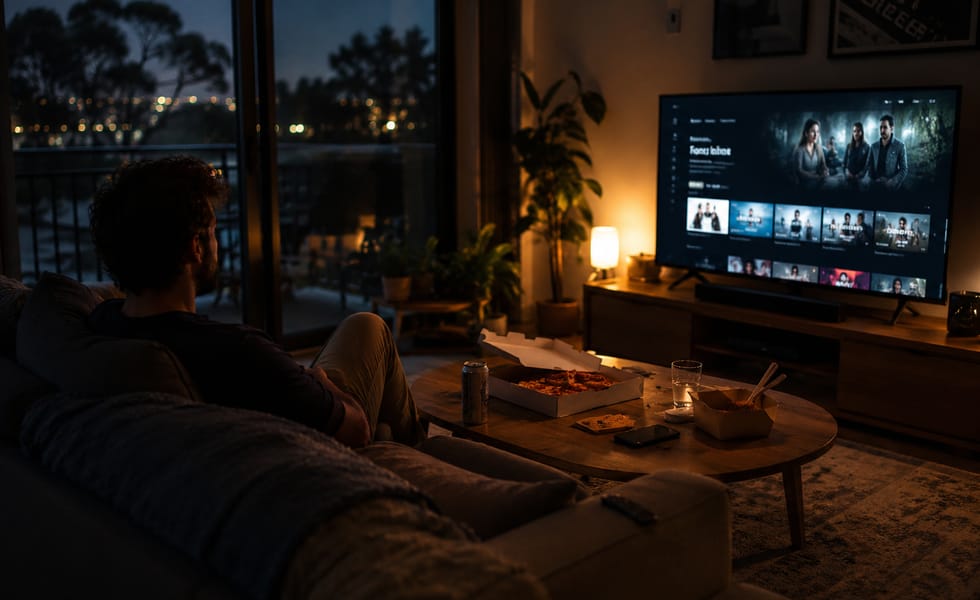
There’s a quiet shift happening in how people spend their weekends.
Not dramatic. Not announced. Just noticeable over time.
Fewer automatic nights out. More decisions made on the couch.
Across regional New South Wales and Victoria, the rhythm is changing. Places that once relied on steady foot traffic, pubs, cafes, local venues, are still there, still valued, but no longer the default. Going out has become something more deliberate. Something planned.
Staying in, on the other hand, has become frictionless.
It’s not just about saving money, although that’s part of it. Cost of living pressure has made people more selective. But the bigger shift is convenience. The ability to access entertainment instantly, without coordinating people, transport, or time.
Streaming, food delivery, gaming, live content, all of it sits within reach. No waiting, no travel, no variables.
That ease changes behaviour.
A night that might once have meant heading to a local venue now competes with a setup that’s already there. Comfortable, predictable, and increasingly high quality. The gap between going out and staying in has narrowed to the point where it’s no longer an obvious choice.
That doesn’t mean physical venues are disappearing.
They still carry something digital spaces don’t. Atmosphere. Social energy. The unpredictability of being around other people. But they’re being repositioned. Less routine, more occasion.
People still go out. Just not as often, and rarely without a reason.
This is where the pressure builds for local businesses. It’s not about replacing what they offer, but competing with a different kind of alternative. One that doesn’t operate on the same terms.
At-home entertainment doesn’t need staffing, space, or overheads. It doesn’t rely on foot traffic or weather. It just needs to work.
And increasingly, it does.
Even within digital spaces, expectations have shifted. People look for seamless experiences, minimal friction, and a sense that time spent is rewarded in some way, whether that’s progression, engagement, or simply distraction that holds attention.
Some corners of the internet track these behavioural patterns closely, including discussions around payout casinos published through platforms like GamesHub, though the broader takeaway isn’t about gambling itself. It’s about speed, responsiveness, and how quickly people now expect systems to react.
That expectation doesn’t stay contained.
It spills over into everything else.
Ordering food. Booking tickets. Choosing where to spend time.
If something feels slow, clunky, or uncertain, it gets abandoned.
Local venues feel that shift, even if they’re not directly competing with digital platforms. The comparison isn’t always conscious, but it’s there. Service, convenience, and value are no longer judged in isolation, they’re measured against whatever else is available in the moment.
And the moment usually starts at home.
Looking ahead, this doesn’t point to decline. It points to adjustment.
The venues that continue to draw people in are the ones offering something that can’t be replicated on a screen. Not just food or drinks, but presence. A reason to leave the house that feels worth it.
Because staying in will always be easier.
The question now is when going out feels better.
MORE IN Culture