Adam Scott’s author confronts his past and the unknown in Damian McCarthy’s Hokum.
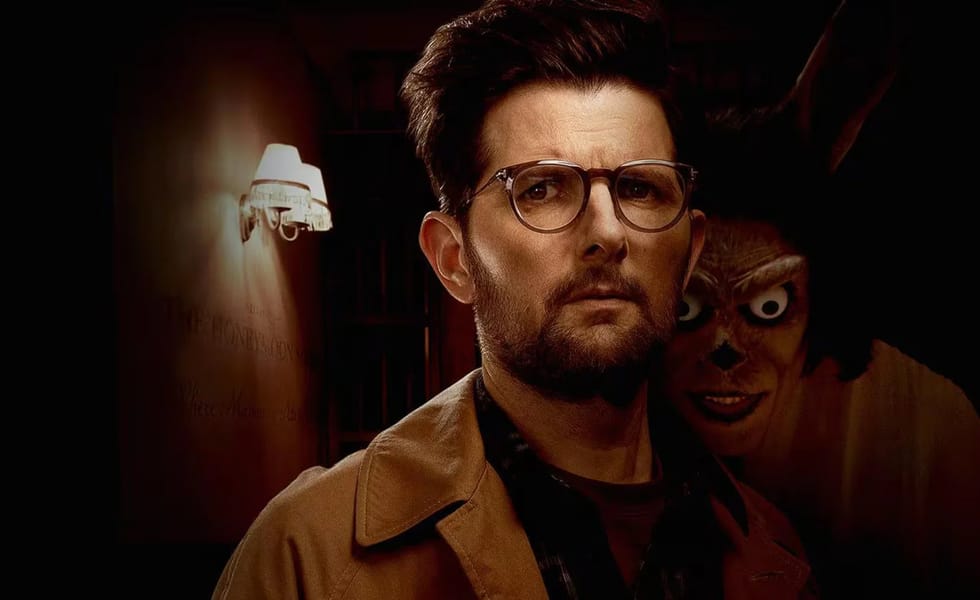
Oddly named author Ohm Bauman (Adam Scott), prickly and depressed, takes a trip to Ireland to scatter the ashes of his late parents near the Bilberry Woods Hotel, the remote inn where they spent their honeymoon. Surly and snarky, he doesn’t make much of an impression on most of the staff, except for friendly bartender Fiona (Florence Ordesh). When she disappears during a Halloween party, he feels he should help find her, a course of action that leads to him investigating the closed and reputedly haunted honeymoon suite. Is it haunted? Well, yes. But there’s more to it than that.
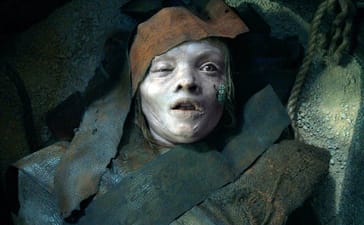
Hokum marks the third feature film from Irish writer and director Damian McCarthy. Like his previous works, 2020’s Caveat and 2024’s Oddity, it’s, well, odd. You can file it under Folk Horror, certainly, but one thing I dig about McCarthy’s work is his refusal to explain or pigeonhole the events. The monster at the heart of Hokum – the non-human monster, that is; people, as ever, are the worst – is a ghost, or a witch, or possibly the ghost of a witch. Or it may be something else altogether. We get a cool little ghost story from hotel owner Cob (Brendan Conroy) that gives us the local folklore, but we’re kept off balance for much of the running time, which helps build up a beautifully creepy feeling of growing unease.
Yet while there are frights to be had, they’re kind of fun – McCarthy has a keen sense of his genre, and he knows his audience does too. He knows we’ve seen The Wicker Man and The Shining and lots more beside, and so there’s a sense of playfulness to Hokum. Getting scared can be fun, after all.
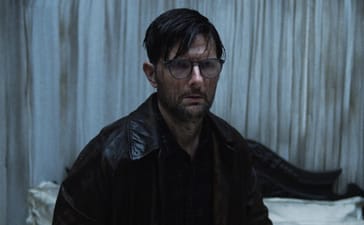
But the whole thing is anchored by a serious, haunted performance from Adam Scott, an actor who has done drama before, but is best known for his comedic work. It’s something to see Scott play a real asshole, and Bauman most certainly is (he’s also a writer of truly dreadful historical fiction, judging by the scenes from his novel that bookend the film). Hollow-eyed and angular, Ohm is obviously tormented by something, and he’s generally happy to take it out on whoever’s handy. It’s a testament to Scott’s performance that we wind up in a place where we can understand his pain and even empathise with him, even if actually liking him is a big ask.
But the movie is easy to like. Over the course of his three features, Damian McCarthy has proven that he excels at evoking the feeling that we are touching on the beyond, lightly brushing our fingertips over the unknowable. His monsters aren’t necessarily evil, but they are other, operating according to rules we can only lightly apprehend, filtering the experience through old myths, legends, and folk tales. That’s a difficult trick to pull off – the idea that the old stories aren’t the truth, but rather the framework through which we try to make sense of the truth. That he manages to connect that to Bauman’s attempts to process his own trauma is even more impressive. Hokum doesn’t rewrite the horror rulebook, but it certainly adds its own weird chapter.
MORE IN Reviews