Amyl and the Sniffers manager Simone Ubaldi has attacked photographer Jamie Nelson following the settlement of Amy Taylor’s photo lawsuit.
Her statement includes a misleading account of a court ruling and finishes with a personal insult. But Taylor opposed the disputed sales, sued, and has now accepted an agreement allowing the covered sales to continue.
The legal battle between Amyl and the Sniffers frontwoman Amy Taylor and Los Angeles photographer Jamie Nelson is finally over.
Taylor’s manager, Simone Ubaldi, responded with a lengthy statement circulated through music media, including The Music, disputing Nelson’s account of the settlement.
Her argument is that Nelson received no damages payment, lost other legal battles and was wrongly portraying a mutual settlement as a victory. Those are points worth examining. But the statement goes further, accusing Nelson of craving attention and ending with this:
“Lie down with dogs and you’ll get up with fleas. Be careful who you let into your world.”
Ubaldi says the band had “never hired a publicist” for the dispute. But this is not a manager without media experience. In a 2024 interview with One of One, Ubaldi described two decades working as a freelance music and arts journalist and discussed her experience in marketing and communications.
That background makes the tone of this statement more surprising. Someone with that experience should understand why an accurate account of court proceedings is important for the band and also the industry. They should understand why personal insult is a poor way to conclude a factual rebuttal.

Taylor sued over the sale of photographs.
The dispute began with a May 2025 shoot for Vogue Portugal. Taylor said she agreed to a magazine editorial, not the later sale of fine-art prints and a photo zine. Nelson said she owned the copyright and could sell the artwork she created.
Taylor’s representatives objected, her lawyers demanded the uses stop, and Taylor filed a federal lawsuit in December 2025. Nelson brought copyright counterclaims of her own.
Nelson can still sell the covered photographs.
The parties agreed to end their remaining claims in October, with each side bearing its own legal costs and fees in the federal case. Both sides say no settlement payment changed hands.
Blunt reviewed the joint dismissal and signed covenant not to sue. The covenant protects Nelson’s specified fine-art sales and display of the photographs, while preserving limits concerning separate product advertising and suggestions of Taylor’s endorsement.
Taylor’s representatives acknowledge that Nelson can continue selling the covered photographs. That does not make Nelson the winner of every legal argument. But it is a significant practical result in a dispute brought to restrict those sales.
Taylor’s federal false-endorsement claim was dismissed with prejudice.
Taylor alleged Nelson’s marketing falsely suggested the singer endorsed or was commercially associated with the products. The judge examined the promotional material, including screenshots of fans who believed the prints were a joint collaboration.
In September, US District Judge George H. Wu found that those allegations did not satisfy the applicable legal test and dismissed the federal claim with prejudice. Taylor’s separate California publicity-rights and implied-contract claims survived that stage. They were later settled, not decided at trial.
Ubaldi says Nelson’s dismissal motion failed. It didn’t.
In listing Nelson’s supposed defeats, Ubaldi’s statement says her “motion to dismiss failed”.
The September ruling expressly granted the motion in part and denied it in part. Nelson did not have Taylor’s entire case dismissed, but she did secure the permanent dismissal of its federal false-association claim.
For a statement accusing someone else of misrepresenting proceedings, that is a significant omission.
The “right to say no” does not settle the legal question.
Ubaldi says Taylor was simply fighting for “Amy’s right to say no”. Taylor was entitled to advance that position. But objecting to a proposed use does not automatically establish that a photographer is legally prohibited from selling copyrighted artwork.
Equally, copyright ownership does not automatically defeat an enforceable agreement or a subject’s publicity rights. That was precisely why Taylor’s remaining claims survived the dismissal motion. Neither side obtained a trial ruling resolving those claims.
The agreement nonetheless permits the specified fine-art sales to continue.
The money figures are not proof that the sales were unlawful.
The statement says Nelson demanded US$750,000 through her copyright claims and received nothing. The precise demand is not established by the federal dismissal filing, and Nelson’s counterclaims ended too.
It also refers to a $10.5 million combined valuation of photographs. That is a calculation based on listed prices and hypothetical sales, not evidence that Nelson earned millions.
Money is relevant to the scale of the dispute. Neither number proves that Nelson’s sales were unlawful. Nor does the absence of a damages payment erase her ability to continue the covered sales.
Taylor’s camp had already claimed a sweeping court victory.
In March, Taylor’s lawyer Jonathan Pink told Rolling Stone a hearing represented a “near-complete victory”.
Blunt reviewed the hearing transcript and reported that the judge had not declared such a victory. He was urging both parties towards mediation and said there was “no telling who is ultimately going to win”.
So Ubaldi’s latest claim that “we have never made a statement” needs qualification. Taylor personally may have kept quiet, but her lawyer publicly promoted an interpretation of the hearing.
Ubaldi previously challenged Blunt over its reporting.
In April, Ubaldi contacted Blunt directly, saying our coverage was “just plain wrong” and “you’ve got the facts wrong”. She asserted that a final judgment had ruled in the band’s favour on the relevant motions.
We asked for the court document or docket reference supporting her claim. None was provided in response. We published the messages and our examination of the transcript. The case was still ongoing, and the sweeping final judgment she described had not been issued.

That history shows a pattern that continues when assessing the accuracy of the latest statement. It also makes the contrast between the court record and the public messaging worth examining.
The other legal battles were messy, and both sides took hits.
The lawsuit produced a series of related legal fights and procedural arguments:
- Nelson’s civil harassment restraining-order application was rejected.
- Her anti-SLAPP motion failed.
- Her copyright infringement counterclaim was dismissed without prejudice, with permission to amend, while a separate declaratory claim survived.
- Taylor lost her federal false-endorsement claim, and the band company failed in its challenge to US jurisdiction.
None of this amounts to a clean court victory for either party. But these side battles do not change the agreed outcome on the original dispute over selling the photographs.
The personal insults are no substitute for the facts.
Ubaldi’s statement characterises Nelson as someone who “desperately wants attention” and suggests she has misrepresented the case. The manager is entitled to dispute Nelson’s victory narrative, but motives are not established by assertion and a fair account should acknowledge the motion Nelson actually won.
Then comes the dogs-and-fleas sign-off. It adds contempt, not an explanation of the settlement. For a band operating at Amyl and the Sniffers’ level, it is reasonable to question the judgment behind sending that statement.
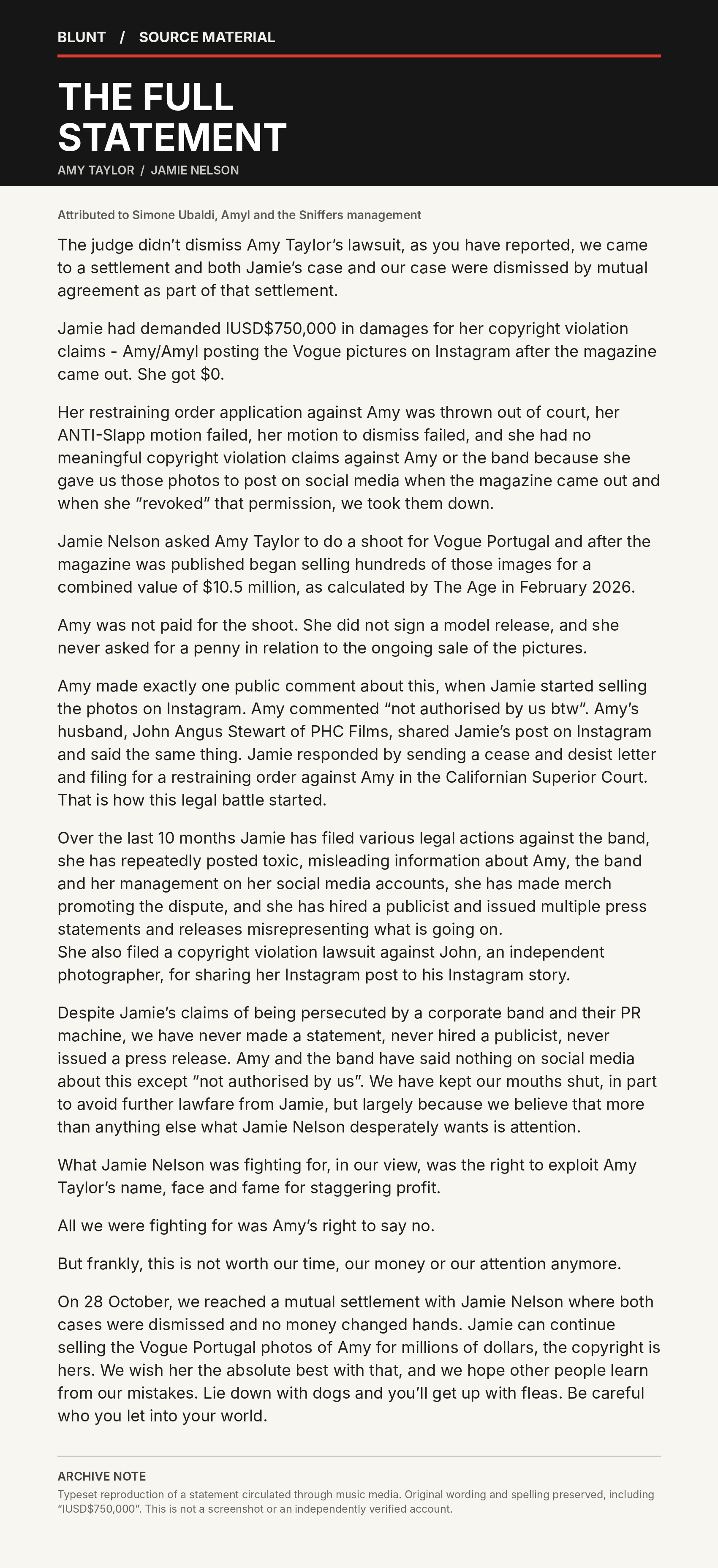
Read The Statement in Full
Blunt has reproduced Simone Ubaldi’s complete statement as circulated to music media. An earlier indexed version of The Music’s coverage included passages concerning Nelson’s alleged US$750,000 damages demand, the $10.5 million print valuation and management’s account of the court rulings. Those passages were absent from the version Blunt checked on 2 November. The reason for the changes is unknown. [Read the statement in full.]
The settlement says more than the spin.
Nelson did not win every court fight. Taylor did not lose every claim. Both sides spent time and money on a dispute that became increasingly personal.
But the central facts remain: Taylor sued over the disputed sale of photographs. Her federal false-endorsement claim was dismissed with prejudice. The remaining claims were settled. Nelson can still sell the covered photographs.
After all the money, legal manoeuvring and competing declarations of victory, that is the outcome worth remembering.
And after all that, Taylor’s manager chose to finish with a personal insult.
Amyl and the Sniffers deserve a better closing argument than this.
MORE IN Music