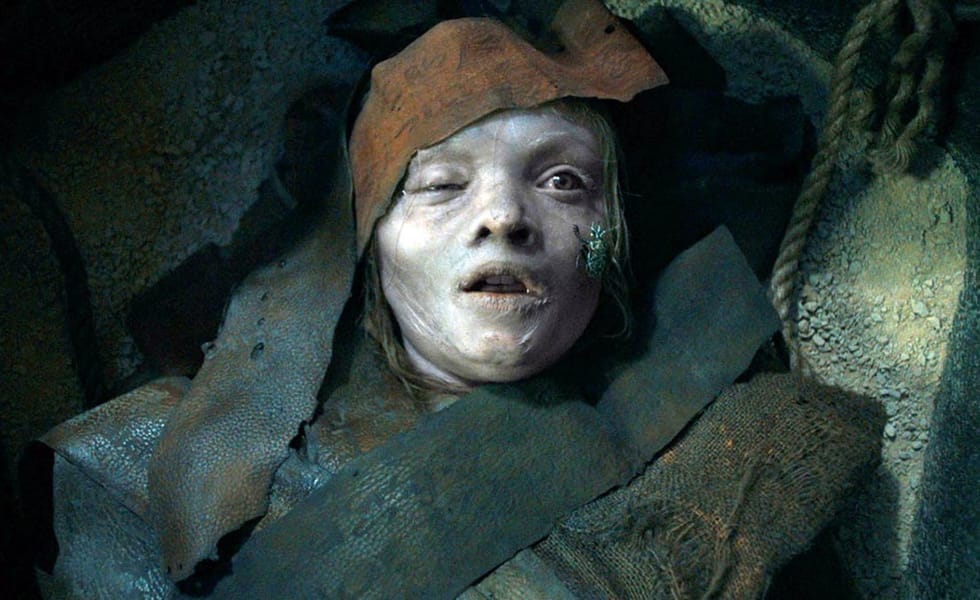
Lee Cronin’s The Mummy is a particularly mean-spirited Evil Dead film wrapped in bandages, but it can’t outrun its legacy.
Eight years after their young daughter Katie (Emily Mitchell as a child, Natalie Grace later) vanished, foreign correspondent Charlie Cannon (Jack Raynor) and his wife Larissa (Laia Costa) are elated and appalled when she is unexpectedly returned to them. Elated because, well, you would be, wouldn’t you? Appalled because she’s found in the wreckage of a crashed airplane, wrapped in ancient parchments and lying in an ancient sarcophagus. It’s worth noting she disappeared in Egypt where Charlie was on assignment. That and the title indicate where this is going.
What do you do with The Mummy? It’s a tough question. The big guns of the Universal Monsters are remarkably elastic creatures. You can do a lot with Frankenstein, Dracula, and even the Wolf Man – indeed, all three have featured in remakes over the last few years. The Mummy – at least, as conceptualised in the 1932 film starring Boris Karloff as the bandaged bad guy – is less flexible, which seems appropriate. Conceptually, it’s steeped in colonialism, Orientalism, and no small amount of xenophobia. Stephen Sommers got around that by reconfiguring the whole thing as a two-fisted Indiana Jones-style adventure, the pulp posturing allowing us a little distance from all those unfortunate implications. Lee Cronin, fresh off 2023’s Evil Dead Rise, stumps for making a particularly mean-spirited Evil Dead film, more or less.
Interestingly, Lee Cronin’s The Mummy – a title mandated to differentiate it from an upcoming third sequel to Sommers’ film – covers similar territory to Curry Barker’s Obsession, albeit with roughly 30 times the budget. Like Obsession, what we have here is a covert possession film in the vein of The Exorcist or Hereditary. The Katie who comes back is clearly not Katie – to us as viewers, at least. Her family, however, do their best to ignore her cadaverous appearance, her shrieks and acts of self-harm. It’s harder to ignore her psychically controlling her siblings, though, or having her grandmother (Verónica Falcón) eaten alive by a pack of coyotes. There’s something ancient and evil in that kid, and the film bifurcates, following Egyptian detective Dalia Zaki (May Calamawy) in one thread as she runs down the mystery of what happened to Katie, while back home in New Mexico the Cannon family contend with the return of their little bundle of body horror.
Indeed, body horror is the order of the day here, and Curry delights in assaulting us with an impressive variety of icky and unsettling sights, spattering the screen with blood, viscera, and vomit. The sheer volume and variety of gore is impressive, if exhausting; by the time we hit the credits after a whopping 133 minutes, the ultimate effect is numbing. We’re just ground down by the unpleasantness, to the point where the impact is considerably lessened.
A for effort, though – the sheer audacity of some of the imagery is impressive, even if its in service to rather opaque goals. And while Cronin goes to great lengths to put some distance between himself and the Orientalism inherent in the Mummy concept, he can’t escape it. We get a female Egyptian detective as co-protagonist, and Larissa and her doomed mother are implicitly Hispanic, but we’re still watching a wealthy Western family contend with horrors arising from having made the unforgivable mistake of travelling overseas. The threat is the foreign “other” – the corrupt and corrupting influence of alien cultures. More than anything, it reminded me of Dan Simmons’ novel Song of Kali, an incredibly effective and crazy racist book about a guy who makes the mistake of taking a trip to India. Unfortunate implications abound, and The Mummy isn’t deft enough to do anything interesting with them.

Lee Cronin’s The Mummy is now streaming on HBO Max.
MORE IN Film