Wishes do come true in the most horrible way imaginable in the game-changing Obsession.
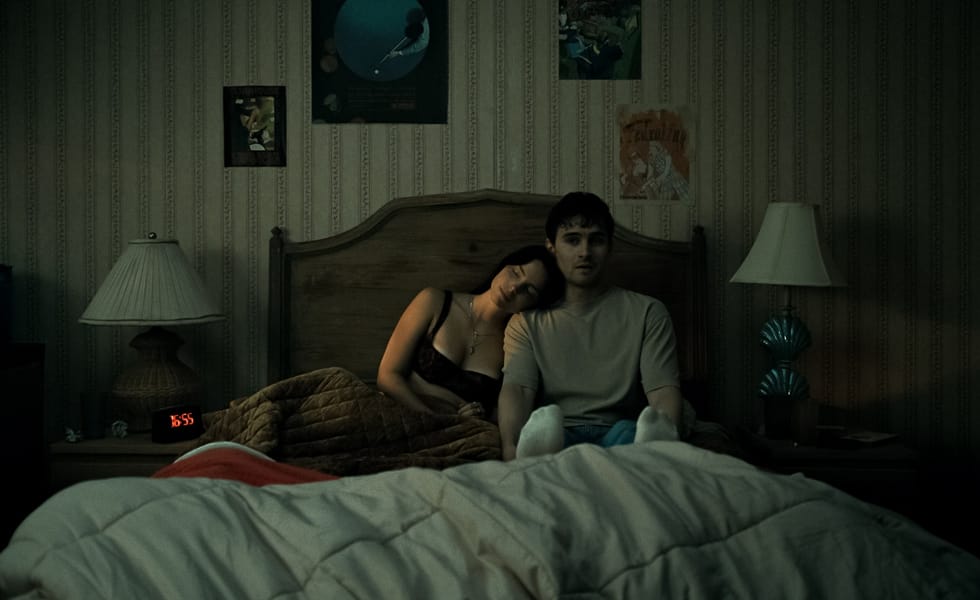
Lovelorn music store employee Bear Bailey (Michael Johnston) has been nursing a crush on his friend and co-worker Nikki Freeman (Inde Navarrette) since childhood, but can’t bring himself to make his feelings known. Having once again failed to shoot his shot, he half-jokingly, half-desperately makes a wish on a One Wish Willow, a novelty gift he bought for her: “I wish Nikki Freeman loved me more than anyone in the fucking world.” Good news! It works. Bad news! It works…
Obsession is the second feature film from YouTube comedian Curry Barker following 2024’s Milk & Serial. That one was released on YouTube, having failed to secure a distribution deal. By contrast, Obsession is one of the biggest films of 2026, earning over US $400 million on a slim $750,000 budget and beating the pants off of blockbusters like The Mandalorian and Grogu, Masters of the Universe, and Supergirl. Add to that the fact that it’s coming on the heels of Backrooms – also low budget horror, also birthed in the bowels of the internet – and it feels like an epochal shift: a rejection of the four quadrant tentpole model. Reports of studios scouring Reddit for film fodder are coming in. Of course they are.
This happens from time to time. It happened when Easy Rider hit in 1969. It happened when Sex, Lies, and Videotape hit in 1989. We got good things, culturally speaking, downstream of both of those. The nascent Obsession/Backrooms indie boom seems to be 17 years late, but we’re talking movies, not cicadas here. Besides, whether we even get another boom out of their success is not guaranteed. The landscape is radically different now. It’s hard to say.
It’s easy to say that Obsession is an excellent horror film, one that speaks to both the moment and to some uncomfortable, unpleasant truths about friendship and romance – real or unrequited – and the way some men feel entitled to the affection and attention of the women in their lives. I say “some men”, but “some women”, too, sure, just to be fair. Obsession is specific in its scenario and details, but its dynamics are horribly familiar: the lovestruck dweeb, the oblivious object of his affection, the small circle of friends burdened with both the knowledge of their non-situation and their own emotional agendas – in this case co-workers and friends Ian (Cooper Tomlinson, Barker’s comedy partner) and Sarah (Megan Lawless). It cants into horror so easily, thanks to the addition of the One Wish Willow, a gimmick that feels like it’s lifted from an old episode of The Twilight Zone – in fact, it was reportedly inspired by an episode of The Simpsons.
But the horror comes quickly, as do the results of the wish – seconds after the dejected Bear making hiss desperate wish, Nikki is inviting him into her home. They’re quickly inseparable, to the surprise of their friends and to Bear’s growing unease. The title is unsettlingly playful and ambiguous. There’s Bear’s obsession with Nikki, sure, but then there’s post-wish Nikki’s obsession with Bear. She watches him while he sleeps. She screams that he doesn’t really love her. She’s erratic and explosive. She digs up his dead cat and makes him a sandwich from its meat.
That last one should be a dealbreaker, but whomst amongst us hasn’t stayed in a relationship way past its use-by date? And who hasn’t pretended to be something they’re not? That latter point comes to the fore as it becomes readily apparent that post-wish Nikki, dubbed “Freaky Nikki” in the film, isn’t really Nikki; something is controlling her, and doing its level best to fulfill the conditions of Bear’s wish. The “real” Nikki breaks through from time to time; at one point she begs Bear to kill her. For his part, he tries to change the conditions of his wish, but not actually undo it.
Well, what a piece of shit, hey? Unarguably, but Barker plays smart games with our empathy as viewers, putting us in Bear’s shoes and then forcing us to watch as he makes mistake after mistake and transgression after transgression. We’re denied that kind of deep connection with Nikki, meeting her only briefly before the plot kicks in and Freaky Nikki is in the driver’s seat. We’re forced to parse everything through Bear’s point of view, and that includes our view of Nikki, who goes from pedestal-placed object of affection to bunny boiler in an instant, with no stops in between.
That term, “bunny boiler”, refers to Adrian Lyne’s 1987 smash hit Fatal Attraction, in which a philandering Michael Douglas is menaced by his one night stand, played by Glen Close. That, too, was an epochal film that centred an awful man, but in Lyne’s hands Douglas’ character is hapless but still heroic, battling to protect his family from Close’s unhinged third wheel. Barker’s smartest play here is to make Bear a more pathetic figure, but still an empathetic one.
Which is messy and uncomfortable, but thematic messiness is one of Obsession’s key strengths, contrasting the clockwork precision of its plot. Sure, there’s a strong moral message at its core – don’t rob women of their agency to assuage your own loneliness remains a perennial banger – but Barker’s circuitous route to that thesis is what makes Obsession sing. Odds are, that isn’t easily replicable, but it’ll be fun to see people try.

Obsession is in cinemas and on VOD now.
MORE IN Reviews